Popular Posts

Showing posts with label cannibal holocaust. Show all posts

Saturday, 16 March 2019

Art vs Artist: Can We Separate Entertainment From Those Who Tainted It?

[Reader disclaimer: this piece contains material of a sensitive nature].


Roman Polanski on the set of Rosemary's Baby (1968)

Following the controversies surrounding Leaving Neverland (2019), wherein the documentary follows Michael Jackson's child abuse allegations, and recent war between actors Amber Heard and Johnny Depp (which has now alluded to both being victims and perpetrators of domestic violence), there has been a question and thought on everyone's mind: are we still allowed to like the films/music they've made?

I've talked with people in my life about this, some of which argue that you are indeed able to seperate a problematic person from their format, others that disagree and say that by supporting someone's film/song/product, you are complicit in supporting that artist as a person. 

For me, I find this to be a difficult question to answer. On the one hand, one person's actions should not condemn a whole film: one actor does not equate to an entire movie, there are directors, cinematographers, producers, camera technicians, special effects and makeup teams...the list is endless. They were not responsible for a leading man/woman's faults. 

However, that being said, I recently watched Moon (2009) for a review, and despite him not even appearing on screen, the sound of Kevin Spacey's voice made me feel incredibly ill. It didn't detract from the whole experience of watching the film but it certainly made me uneasy just hearing him be in it.

Stanley Kubrick and Shelley Duvall on set of The Shining (1980)

We as a society are not unused to hearing people in the film industry attempting to veil their sins off-screen, unfortunately. One of the biggest directors in Hollywood, and one of the most problematic ones, was Stanley Kubrick, who you will undoubtedly know as the man who directed such iconic films like The Shining (1980), 2001: A Space Odyssey (1968) and A Clockwork Orange (1971).

His talents made for some of the most intriguing, awe-inspiring scenes we have ever seen in cinema, and I think that goes without question. But if we strip away his art, if we look at who he was as a person, Kubrick was a self-aggrandising bully on-set, an artist with an inflated ego and a short temper.

He is renowned for his mistreatment of leading actress, Shelley Duvall, who went on to have many mental breakdowns and was as recently as 2016 seen to be suffering from severe mental illness: that is not to say that I'm accusing Kubrick of inflicting Duvall with that but it certainly seems that his influence back in the early 80s left Duvall with arguably severe bouts of PTSD. That is, of course, just speculation...but I digress.

Victor Salva on set of Jeepers Creepers (2001)

Another director who has faced controversy is Victor Salva, which I wasn't aware of until recently (a few years back, I'd say) had been convicted of molesting a 12-year old boy and possessing child pornography.

Insane, right? Surely, then, he was blacklisted from ever making films again.

Wrong.

In fact, after a five year hiatus, Salva went back to being a fulltime film director, his latest project being as recent as Jeepers Creepers 3 in 2017. When I discovered his previous convictions, I was absolutely appalled to know that he was still praised in the inner circles of horror fandoms and still given the time of day to create anything. Then again, people still love Roman Polanski, and he's a straight-up rapist. 
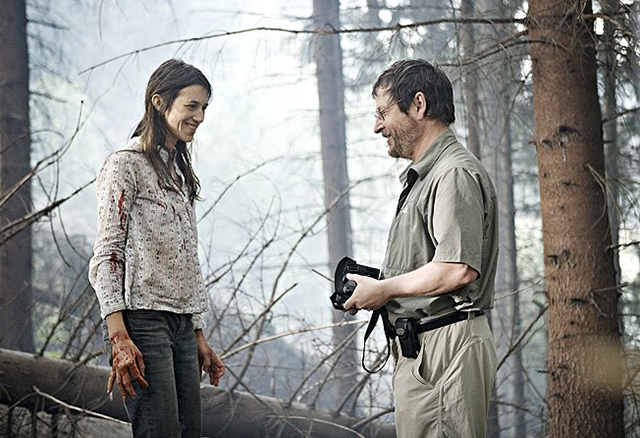
Charlotte Gainsbourg and Lars Von Trier on set of Antichrist (2009)

Tobe Hooper. Lars Von Trier. Quentin Tarantino. Ruggero Deodato. 

The list is endless. And these are just horror/thriller directors, I'm not even mentioning the countless others that have committed pretty horrendous crimes within Hollywood.

So why do we still watch their films? Should we watch their films? 

From what I can gather, it's largely down to personal preference. Society claims to maintain a moral compass when it comes to this sort of thing, ready to blow the whistle on anybody willing to step out of line, but if we're being entirely honest here, some of us just...let things slide. 

It's hard, I guess, for some people to accept that their heroes or idols are problematic, indeed, sometimes even as far as dangerous, because we crave what they create. As a consumerist species, we thrive on new film releases, glue ourselves to the TV for the next episode, tune in to the radio or Spotify to hear the new top 40 because entertainment is made for everybody to enjoy. 

But recently I've found myself noticing that a lot of people make excuses to keep that influx of entertainment going, at a point where they will disregard fact and evidence of wrongdoings to ensure that those creative products keep coming out.

Ruggero Deodato on set of Cannibal Holocaust (1980)

This is, of course, not to shame anybody. I am guilty of this myself: whilst I refuse to buy it because I don't want to support distribution of it, I still enjoy Cannibal Holocaust (1980). It's a horror film. It was made to be consumed and enjoyed. Of course I can't stand that they murdered and filmed animals for the sake of their "art" but whether I watch it or not, it's still out there and it's still watched by others.

I think that we've come to a point in time where if we see behaviour that is unacceptable, regardless of your status, you need to be removed from the entertainment industry pending investigation. Kevin Spacey was no exception. Neither was Bryan Singer. Yet we allowed people like Johnny Depp (yes, I know that's a complicated one right now, don't @ me) and Chris Pratt to continue their work because...well...people love them and think they're pretty.

It's so strange to me that audiences will come to the defense of a genuinely shitty person, claiming that "I know he/she would never do that!" as if they have any real impact of their lives as celebrities. You don't know these people and, chances are, they don't know you: they're paid to dazzle you with their acting abilities, they're paid to entertain. Funnily enough, I don't want to pay to see a rapist or a paedophile or an abuser act for me because I'd rather see them rot in prison.

Gunnar Hansen and Tobe Cooper on set of Texas Chainsaw Massacre (1974)

So, what do you think? Can we separate art from their artists? Are we allowed to enjoy the creative product without praising the one who makes it? Or do we disregard art if it's created by someone who does not respect the law or the moral boundaries that humanity has set in place?

- K


Saturday, 13 October 2018

Recommendations: Body Horror

[Reader disclaimer: there will be spoilers discussed. This piece also contains material of an extremely graphic nature].


The Thing (1982)

Horror, in its purest form, is a genre founded on its ability to disgust, shock and terrify its audience. It has many different sub-genres, one of which is 'body horror', a sub-genre centered around human (and sometimes foreign/alien) anatomy: what makes body horror so fascinating to others is the way in which it distorts the familiar and makes us uneasy in the way that it essentially unravels what we inherently know about ourselves.

For example, most people cannot stand to watch open-heart surgery or eye laser treatment, because these are vulnerable parts of the human body that undoubtedly cause people a lot of pain when tampered with. So, in body horror, this is elevated to an extremist level, beyond our comprehension of pain and deformity.

It crosses over into other genres as well, mainly science fiction, but also adventure, thrillers, even under the category of animation in some countries. But at its core, body horror is exactly that: horror of the body.

That being said, there are people (me included) who relish in watching body horror. For me personally, I do enjoy watching it: maybe I am desensitised due to years of watching horror movies, or maybe I'm just innately a sadist, but for whatever reason, it's one of my favourite sub-genres. This list is for those who would like to give it a go or simply for those that want new ones to watch.

Hellraiser (1987)


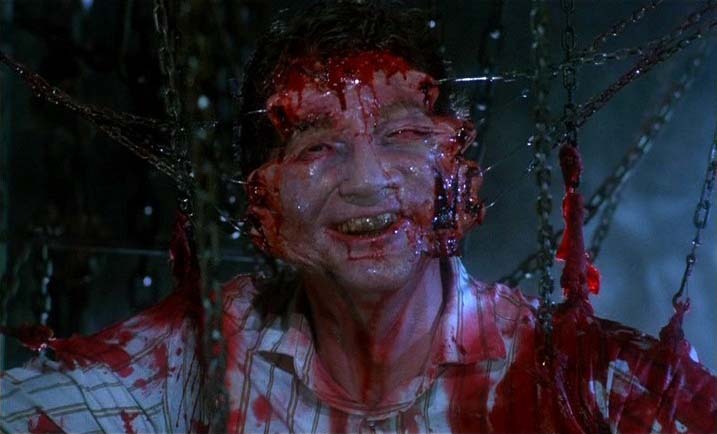
Let's start with something easy. Hellraiser (1987) is a horror film from the late 80s, back when body horror was becoming the height of popularity. It is a staple amongst fans and is culturally recognised as a film with one of the most iconic villains in history (Pinhead). However, if you haven't actually seen Hellraiser, then you may not know that Pinhead is more of a secondary antagonist than the movie's main villain. The main villain, pictured above wearing someone else's skin (I know, pretty grim), is a character named Frank Cotton.

Hellraiser is a film I will always recommend to people who want to watch horror films, whether they're interested in body horror or not, because the foundations of the narrative are based around the culture of sadism and lust, a sort of glamorous and gory representation of greedy human nature. Their victims usually end up disfigured or torn to shreds and that is horror at its finest: sinister, bloody and intriguing. 

The Fly (1986)


The Fly (1986), a remake of Kurt Neumann's 1958 film, is a masterpiece brought to you by none other than the godfather of body horror himself, David Cronenberg. It is a film centred around the  scientist Seth Brundle, who has worked out how to teleport himself from one of his pods to another. A marvellous invention, really, until he teleports with another organic lifeform inside...a fly. 

You can imagine how that goes. The computer can't distinguish the two lifeforms and so blends the DNA together, creating the anti-hero known as Brundlefly. Pictured above is Brundle (played by the wonderful Jeff Goldblum) mid-transformation, as showing Brundlefly would more or less spoil the surprise for any of you who haven't had the pleasure of seeing the film yet.

The Fly is one of many examples of a hybrid genre (sci-fi horror) that depicts body horror in a way that becomes the antithesis of the character, through either mutation, evolution, devolution or otherwise, using plausible science as means to explain their transformations. I would highly recommend it and any of Cronenberg's other films, such as Rabid (1977), Scanners (1981), Videodrome (1983) or Naked Lunch (1991).

Akira (1988)


An unusual addition to the list, mainly due to its format rather than its content, is Akira (1988). This film is popular amongst fans of both body horror and anime due to its graphic depiction of genetic mutation through animation.

The antagonist, Tetsuo (voiced by Nozomu Sasaki), resides in a post-apocalyptic version of Japan, and is drastically altered by the military into a grotesque psychopath. Akira's success, it would seem, is mainly down to its world building: the characters' traumas and evolvement both physically and mentally can be attributed to the fantastical neo-Tokyo setting in which they must learn to adapt to or fight against.

Akira certainly conveys what other body horrors tend to forget, which is the mentality of the victim. Tetsuo is a brash and reckless character for sure, but his mutation is met with anguish, confusion and sadness, something that the audience can empathise with (despite his murderous rampage later on in the plot). Another film similar to Akira would be Tetsuo: The Iron Man (1989), which follows a similar vein of Japanese body horror that blends man and machine but also conveys the character's struggles, humanising them despite their mutations.

Splice (2009)


There are many sci-fi horrors I could add to this list, so I'll stop here with this Canadian-French body horror, one that isn't as well-known as the previous two. 

Splice (2009) follows two geneticists (played by Sarah Polley and Adrien Brody) that are working on splicing the DNA of animals and humans to create a hybrid that can be of medical use. This results in the creation of Dren (pictured above), a humanoid creature with a stinger and retractable wings. But it never goes well for people who "play God" in the movies, now does it? 

Mayhem ensues, though I'll leave the ending out of it for anyone who wishes to give this forgotten gem a go. It makes this list for its excellent use of body horror, in a way that doesn't necessarily show a lot of gore, but definitely shows what could be another step in human evolution (or, at least, evolution gone wrong). 

Black Swan (2010)


Brought to you by a director known for the unsettling and frankly disturbing film Requiem for a Dream (2000), which in its own right incorporates elements of body horror as well, comes Black Swan (2010). A psychological horror directed by Darren Aronofsky, this film truly encapsulates body horror in a contemporary and artistic way.

The plot is centred around ballerina Nina Sayers (played by Natalie Portman) in her strive for perfection, though as she works harder and harder, her place in reality and her grasp of her own sanity begins to fall apart. This film is executed masterfully through the use of Clint Mansell's soundtrack, costume design and special effects and remains one of my favourite examples of body horror. 

Nina's descent into madness is truly a frightening yet thrilling watch, focusing more on an aspect of body horror that orbits around metamorphosis rather than just a general transformation: her character transcends the our reality, just not in the way that it probably should. The Fly, as previously mentioned, would also fit into this category.

Repo! The Genetic Opera (2008)


A format that I would absolutely love to see more of is body horror within unconventional genres, such as musicals. That's essentially what Repo! The Genetic Opera (2008) is: a gothic, science fiction, body horror musical.

Repo! is whimsical yet disturbing in its depiction of a futuristic biotech company profiting off people's need for new organs. It harmonises gore and theatricality quite successfully but it never loses the main essence of body horror, showing the downfall of disfigured main characters like Pavi Largo (played by Kevin Ogilvie, pictured above) and Amber Sweet (played by Paris Hilton). 

Although the plot revolves more around the exploitive nature of capitalism, betrayal amongst family and the element of greed, body horror marries well with choice aspects of this film and does so in both a gratuitous yet artful way. Another musical I would recommend is Sweeney Todd: The Demon Barber of Fleet Street (2007), though that doesn't really fall into the sub-genre of body horror as much as just gothic horror. 

Ichi the Killer (2001)


Those of you who are fans of Japanese horror may or may not have heard of this one, but Ichi the Killer (2001) is a cult classic within the crime horror genre, mainly popularised for its insanely graphic depiction of sadistic torture and quasi-guro elements. 

The plot follows yakuza member Kakihara (played by Tadanobu Asano), a sadomasochist searching for his missing boss. Along the way, he comes across a young man named Ichi (played by Nao Ohmori) who is, essentially, the perfect killing machine: he is perverse, psychotic and able to inflict levels of pain that Kakihara both admires and craves.

This kind of body horror doesn't convey a character's struggles like Akira or The Fly, but presents a character's desires to engage with it. It is almost a romanticism of ultra-violence, popular in other Japanese forms of entertainment such as anime, literature and art. It's certainly a bizarre and downright disturbing film but it uses body horror effectively, and not without reason. One might mistake Ichi the Killer for using unnecessary gratuitous violence, but I would argue that it supports the needs and emotions of the main characters, no matter how grotesque you find them. 

Cannibal Holocaust (1980) and Hostel (2005)


For my last entries on this list, I have grouped together the cult classics Cannibal Holocaust (1980) and Hostel (2005): you might be wondering why, considering both films are completely different in terms of plot and both set in different eras.

However, this is one thing that I wanted to draw attention to when it comes to body horror: it can exist within other sub-genres of horror but that does not make them synonymous. 

Cannibal Holocaust and Hostel are both incredibly gory films, depicting the removal of organs and tampering of human anatomy, however they are both considered part of the 'torture porn' sub-genre of horror as opposed to 'body horror'. Torture porn was popularised in the early 2000s by Eli Roth (director of Hostel) in an ambitious and consequently successful movement to create horror films that showed a correlation between gore and sexualised horror. Roth has stated in many interviews that he was inspired by horror films of the 80s such as Cannibal Holocaust, which he made a homage to called The Green Inferno (2013), a nod to the fictional film featured in Cannibal Holocaust of the same name.

Though featuring elements of body horror, these films are not technically classified as such. I would still recommend them to anyone who would want to branch out into torture porn, though.

Honourable mentions

There are many body horror films, but alas, I can't talk about every single one of them in a singular blog post. I'll list a few more below for anyone who is interested in checking them out, though fair warning, body horror really isn't for horror fans who are squeamish and more prone to watching the psychological or paranormal. Body horror is meant to be gross, and these films certainly are. 

  • Re-Animator (1985)
  • Thinner (1996)
  • Cabin Fever (2002)
  • In My Skin (2002)
  • Slither (2006)
  • Martyrs (2008)
  • Grotesque (2009)
  • The Human Centipede II: Full Sequence (2011)
  • American Mary (2012)
  • Antiviral (2012)
  • Tusk (2014)
  • Bite (2015)
  • Raw (2016)

- K