Popular Posts

Showing posts with label hellraiser. Show all posts

Wednesday, 22 November 2023

Film Reviews: Flesh is the New Black [Hellraiser, 2022]

 Hellraiser (2022)

[Reader disclaimer: there will be spoilers discussed. Please also be aware that this piece may contain material of a violent or graphic nature].


Curiously, despite the failure of the initial attempt to reboot campy, 80s slashers, it appears that we are in yet again another era of modernity dragging our horror classics kicking and screaming into the 20s - you'll recall, perhaps, that this was first attempted in the late noughties: the problem was that Friday the 13th (2009) and A Nightmare on Elm Street (2010) were, to put it politely, abysmal. 

Modern filmmakers lack a crucial ingredient to making these films shine again and that's having an element of camp and fun. So when I heard Hellraiser (1987) was getting a reboot, I was dubious: what makes the original film legendary (other than the spectacular performance from Doug Bradley) is the gooey gore, the angelic soundtrack, the iconic BDSM-inspired outfits that gave us a queer edge to otherwise evil characters. The whole point of Hellraiser is that pain and pleasure intertwine and become something otherly - that's wherein the horror derives.

So, Hellraiser (2022)...how does it compare?

Firstly, I'll note and praise the pros. Jamie Clayton as Pinhead (or known as The Priest in the film) is exquisite. She's strangely alluring, dangerous yet seductive and inquisitive: I'm not saying whether Clayton was better than Bradley, simply that she brought out a different side of the character that we haven't seen before, which I greatly appreciated. 

Following on from Pinhead, I have to acknowledge the other Cenobites (albeit they weren't given enough screentime, in my opinion): the new creatures from Hell come with a flurry of new, grotesquely beautiful designs, including The Gasp (who evidently looks like a mix and match of Deep Throat and Angelique, two iconic cenobites from the original series), The Masque (who may well be a nod to Face from the original books), The Weeper, The Asphyx and The Mother. This new variety of cenobites is definitely an exciting addition, however, some appear for merely seconds of screentime, which was disappointing. I'm surprised Clive Barker hasn't taken a note out of the Thir13een Ghosts (1999) book yet and created an anthology exploring Leviathan lore. 

The soundtrack is okay. Ben Lovett ended up including some of Christopher Young's original score, which I guess was an attempt at being a homage but ended up feeling like a cop-out. The practical effects were surprisingly great but we don't see the best parts of it being applied until the last five minutes of film time. 

And this leads us to the cons: I have absolutely no time for any of the main characters in this film. I did not care about protagonist Riley (played by Odessa A'zion) nor did I care about her resolve to free her gay brother from Hell after she accidentally sacrificed him to the cenobites. There's absolutely no chemistry between any characters, Riley is a scarily-accurate depiction of an addict but there's no sympathy in this writer's soul for her and she gets her comeuppance. If anything, I was annoyed she lives at the end because she says she's reformed and learnt to accept the death of her brother but absolutely none of the plot up until that point indicates this. Perhaps the only highlight of the end was Roland's (Goran Visnjic) transformation into the next cenobite - it felt ethereal and painful at the same time, which is what  this series is all about. 

I'm not saying this was a bad film. It just wasn't great and, at this point in the genre, I only expect greatness from a reboot of something this iconic. It's not as if these film companies only have a few years on their hands to come up with new concepts - Hellraiser premiered nearly 40 years ago. I want to see love in these reboots, a specific attention to detail and ideas that mesh with the original source material. If Nia DaCosta can do it, then surely bigger production companies can. 

Overall rating: 4/10

- K

Monday, 7 December 2020

The Pros & Cons of Franchising

 [Reader disclaimer: spoilers will be discussed].


Hellraiser: Inferno (2000)

Have you ever gone for a meal and thought to yourself, 'you know what? I'll be cheeky and order dessert'. In essence, that's the function of sequels: you just can't get enough the first time round and you're hungry for more.

But, as we all know, sometimes more is too much. The Lord of the Rings works because every film (though connected by source material) work as singularities; if you look at the Hobbit series, 2/3 of the films are arguably lacklustre and co-dependent on the far more successful first instalment. A fan following can only take you so far, after all.

The horror genre is no stranger to sequels, often franchising and building a solid fanbase that follows suit. However, one might argue that franchising a film, no matter how popular it might initially be, can damage the reputation and enjoyment of the original story. 

The Pros


Saw (2004)

Let's look at the pros of franchising. For one, a sequel (or many) can be an exploration of the source material, a chance to expand the fictional universe. Long-time fans, even new ones, will seize any chance they get to see their beloved characters facing new challenges. 

The Saw franchise, for example, brings something new with every instalment: sure, it's all the same torture-porn, characters essentially being punished by a sadomasochist with a God complex, but we enjoy the Saw films because of the creative traps. The simplicity of the first film left room for any crazy device imaginable: from a cuff around the ankles to the Rack in Saw III (2006) and the even more so impressive 10 Pints of Sacrifice from Saw V (2008).

A Nightmare on Elm Street (1984)

Another pro of franchising is, of course, the money; a household name can become a cash-cow with the right kind of marketing. A Nightmare of Elm Street is one of the most recognisable franchises in horror history, not only for its creative kills but for its iconic antagonist, Freddy Krueger (played by Robert Englund). 

So, if you slap Krueger on anything, it's highly likely that the fanbase will come running to watch it. Take Freddy vs. Jason (2003) for example: according to Rotten Tomatoes, it holds a score of 41%, a considerably low number in comparison to the original film (which stands at 94%). However, devoted fans of the franchise still appreciate and love the film because it retains its campy portrayal of the character. Even at domestic box office, it made a profit.


The Cons


The Conjuring (2013)

Now let's look at the cons. One of the biggest issues that franchises face when churning out multiple films is that the lore can become inconsistent and sloppy, consequently creating loose ends and plot holes. The aforementioned Freddy vs. Jason, for example, creates tension by demonstrating Jason's weakness, which is supposedly water: long time fans of the Friday the 13th franchise will find this dubious, however, as Jason is no stranger to water and it's highly unlikely that he's suddenly developed a phobia of it.

The Conjuring series is also victim to this. Whilst the first few movies were actually credible, the following spin-offs (including Annabelle (2014) and The Nun (2018)) are arguably examples of weak storytelling, an overuse of tired tropes and ineffective jump scares. They don't hold the same gravitas as the original films, which actually take the time to create tension and build an interesting concept from the ground up.

The Babadook (2014)

Some creators, such as Jennifer Kent, are aware of the dangers of franchising. Kent (who directed The Babadook) ensured that herself and her producers already owned the rights to a possible sequel because she didn't want there to be another one: in her own terms, it was "not that kind of film", in that The Babadook was intended to be an artful horror that acted as a standalone tale. 

I believe that Kent (as well as visionaries such as Ari Aster or Jordan Peele) understands that it's not guaranteed that a film's integrity gets compromised by franchising, but that if a story is self-contained and well-rounded in its delivery the first time, then that process doesn't need to be duplicated. It would only be for money, after all.

Conclusion


Friday the 13th: Part 8 (1989)

Franchising is not always a death sentence for films. In some ways, the audience and the creators greatly benefit from delving further into the stories we've grown to know and love. However, there's an undeniable correlation between sequels and their performances (both financially and entertainment-wise) that suggests that less is more in most cases.

I love the horror genre but even I have to admit that when it comes to franchises like Hellraiser, Friday the 13th and Saw, I often don't watch past the first three films because they lack in quality, uniqueness and entertainment in comparison to their original debuts. So, I'd argue that franchising is fun but be aware that if your favourite movies start churning out sequels like there's no tomorrow, then maybe it's best to stay clear of them.

- K


Saturday, 15 February 2020

Ranked: Favourite Film Soundtracks

[Reader disclaimer: there will be spoilers discussed. This piece also contains material that might be sensitive to some readers].

There are many components to a film: cinematography, editing, mise-en-scene, lighting, acting. In certain genres, a key aspect tends to stand out more than others, for example, music composition in horror is essential for creating that tension and unease that we typically associate with scary movies (such as the orchestral stab when we experience a jump scare or the rise of string instruments when tension is being built). 

Before the late 20s (with The Jazz Singer (1927) being one of the first examples of films with synchronised speech in it), films often relied on non-diegetic music to demonstrate the emotions of what we saw on-screen. It's still an important component today, however, music has changed drastically since the Silent Era of piano compositions to modern-day remixes and scores on a grand scale.

Here are some of my favourite examples of music used in film.

10) Time by Hans Zimmer - Inception (2010)


Hans Zimmer is one of my favourite film composers. From the macabre yet stunning soundtrack of The Dark Knight (2008) to his playful and enchanting work on The Pirates of the Caribbean: The Curse of the Black Pearl (2003), Zimmer is undeniably talented at utilising every instrument to evoke emotion from the audience.

One of his greatest examples of work (in my opinion, obviously) is the final scene of Inception (2012), in which we see Dom (Leonardo DiCaprio) using the spinning top but leaving to greet his children before we ever see if the top falls or stays upright, leaving the ending ambiguous as to whether or not Dom and the others have returned to reality.

The song Time is played over this sequence, a powerful yet melancholic piece that finishes with lone keys played on the piano. It conveys almost a sadness and provides the audience with a taste of closure before the song abruptly ends on the shot of the spinning top. In comparison to the rest of the soundtrack, Time feels like a solid landmark at the end of the film, one that beautifully marries rising brass and string instruments with the poignant and saddening notes of the piano.

9) The Kiss by Trevor Jones - The Last of the Mohicans (1992)


I can't say that The Last of the Mohicans (1992) as a film has aged particularly well but there are two aspects of this film which are still unfaltering in their impressive nature: Daniel Day-Lewis' performance and the soundtrack.

When I think back to the films I watched as a child and the songs I remember, this one has always stuck in my mind. The Kiss comprises mainly of violins and drums in a romantic, almost Celtic fashion. At this point in the film, Hawkeye (Day-Lewis) seeks out Cora (Madeline Stowe) and they passionately embrace, finally succumbing to their mutual attraction for each other.

As a viewer, this scene is a moment in the making. We witness the romantic tension between the two lovers for so long and desperately await that climactic moment wherein they kiss, so the rise from minor to major chords feels empowering and relieving. 

8) Hellraiser by Christopher Young - Hellraiser (1987)


Talking of films from childhood, this spot on the list had to go to one of my all-time favourites: Hellraiser (1987). Obviously most horror films from the 70s/80s renaissance are indisputably iconic, from Charles Bernstein on A Nightmare on Elm Street (1984), John Carpenter on Halloween (1978) to one of the most famous themes in pop culture, Mike Oldfield's Tubular Bells for The Exorcist (1973). 

Out of all of them, however, I had to nominate Christopher Young's work on Hellraiser. I believe my attachment to this soundtrack is founded in both nostalgia but also due to its likeness to composer Danny Elfman's discography: they both tend to use gothic themes intertwined with classical styles of musical composition, which I think works effectively when it comes to horror films. 

Either way, as soon as Hellraiser starts playing, I'm immediately thrown back to the first time watching it, sitting in absolute awe of Doug Bradley. 

7) Bundle of Joy by Michael Giacchino - Inside Out (2015)


Let's be honest. There are plenty of Pixar soundtracks that could sit on this list. Some of you might be surprised to see that I've picked something remotely new as opposed to something more nostalgia-based from the 90s, such as Toy Story (1995) or Monsters, Inc (2001).

I went to see this film on my 19th birthday and this is one of the first pieces of music to be introduced to us: the birth of Riley (Kaitlyn Dias). This small piece of music, with just the piano alone, evokes this sense of wonderment and childlike happiness that seemingly captures Riley's personality before we're even able to see her character grow up on-screen. It's heartfelt and light, something that Pixar films are most certainly renowned for. 

I believe that if I had seen this film as a child, I would've had a fond nostalgia for its music. As an adult, I can appreciate what Giacchino is trying to translate to his audience and it works.

6) Bunsen Burner by CUTS - Ex Machina (2014)


It came as a surprise to me when I watched Ex Machina (2014) after listening to The Prodigy's 2015 album, The Day is My Enemy because one of the songs on the tracklisting actually samples Bunsen Burner in a more sped-up format. So, every time I listen to the Ex Machina soundtrack, I'm reminded of The Prodigy.

Regardless, Bunsen Burner has been firmly etched into my memory ever since I watched this film for the first time. It's electronic, ebbing introduction fades effortlessly into a strong, three, minor-notes sequence that never feels repetitive, only tense. Within the context of the film, this is the climactic scene of the final act, wherein Ava (Alicia Vikander) turns on her creator, Nathan (Oscar Isaac) and fatally stabs him: we, as the audience, realise Ava's inability to feel true empathy and that she truly is a threat.

Bunsen Burner feels, in a way, like the empowerment of a freed prisoner but also the final curtain of the characters we have grown to trust and even like within the narrative. It's a musical double-edged sword.

5) Rohan by Howard Shore - The Lord of the Rings: The Two Towers (2002)


The entire discography of The Lord of the Rings franchise is impressive. There's no denying that. However, I'd argue that the second film, The Two Towers (2002), holds some of the best use of Howard Shore's work; the grand scale of the battle scenes, the intimate moments between characters, the light-hearted nature of comic relief.

Rohan is my favourite of all these themes, as it's used to both present touching scenes (such as the freedom of Théoden, played by Bernard Hill) but also the more melancholic moments, such as Éowyn (Miranda Otto) lamenting the dying landscape of her home and the ill-nature of her people.

Every geographical location in Middle Earth has its theme and Rohan is distinct in its use of string and brass instruments, conveying an atmospheric feeling of grandeur and unity. 

4) I Got 5 On It by Michael Marshall ft. Luniz - Us (2019)


In his first film, Jordan Peele demonstrated his ability to handpick songs that were absolutely perfect for the narrative, with Get Out (2017) featuring artists such as Childish Gambino and Flanagan & Allen. In his second film, Peele truly stepped up his game by not only delivering some more iconic songs but giving one of the most haunting remixes of an R&B song I've ever heard.

I Got 5 On It, originally sung by Luniz, is remixed with a dramatic, high-pitched underscore, which elevates a formerly relaxed song to a song of panic, paranoia and frustration. This, accompanied with the scene of Adelaide and Red's (both played by Lupita Nyong'o) expertly choreographed fight, makes for both an entertaining yet nerve-wracking experience. 

This trend of taking 80s/90s songs and giving them new life is so enjoyable and I genuinely hope we see more of that in the future.

3) In the House, In a Heartbeat by John Murphy - 28 Weeks Later (2007)


This simplistic piece of music is by far one of the best examples I've seen in a horror film, period. John Murphy's In the House, In a Heartbeat begins with two piano notes, then layers that with a four-chord sequence. This builds louder and louder, eventually transgressing into electric guitar and drums, mirroring the increasingly tense scene it accompanies of Don (Robert Carlyle) abandoning his wife to flee from extremely fast zombies. 

As someone who plays music and finds interest in learning chord progressions, this track opened my eyes to the idea that a song doesn't have to have a lot of fancy notes in order to be impactful. What 28 Weeks Later (2007) does so efficiently is creating even more tension through its music, producing almost a sensory overload for the viewer. 

Don's escape scene in the first act is honestly one of the reasons that I actually favour this sequel over its predecessor film.

2) Mr. Moustafa by Alexandre Desplat - The Grand Budapest Hotel (2014)


Wes Anderson is renowned for his quirky characters, pastel backgrounds and oddly catchy music. Out of all the films he has produced thus far, however, I believe The Grand Budapest Hotel (2014) has the best soundtrack: it's fast paced, dramatic yet completely endearing. 

Much like The Two Towers, this film has musical themes for locations and chapters of the narrative, the best arguably being the Mr. Moustafa theme in which we are introduced to the titular character (played by Ralph Fiennes). It features a variety of sounds, it's pace is typical of iambic pentameter and it's playful rhythm parallels the playful nature of the character itself. 

I adore it, as I adore the film.

1) Death is the Road to Awe by Clint Mansell - The Fountain (2006)


If you're a new reader of mine, or just unaware of my top 10 films in general, then I'd like to explain that The Fountain (2006) is my favourite film of all time. It's generally regarded as one of director Darren Aronofsky's lesser films, despite it featuring A-list actors such as Hugh Jackman and Rachel Weisz, but to me I think it's more of a spiritual journey rather than purely a film.

In the third act, three timelines merge to demonstrate the acceptance of death, how grief is a valid process and how the inevitability of us dying is not always the end. This, shown through stunning, golden-toned sfx, is accompanied by Death is the Road to Awe; this is one of the first experiences I've had where a song made my heart stop, my hair stand on end, my breath shorten. It is, simply put, exquisiteness. 

There's a specific section of this track where the sound falters and then explodes into a crescendo of violins, harmonic choir voices and drums that mirrors the on-screen scene of Tom (Jackman) ascending into the galactic nebula named Xibalba (also known as the Mayan afterlife). It's dramatic, powerful, almost alien. And it's beautiful.

Honourable mentions


Of course, I didn't have room to fit all of my favourites on here, so here are also some honourable mentions:


-
K

Saturday, 13 October 2018

Recommendations: Body Horror

[Reader disclaimer: there will be spoilers discussed. This piece also contains material of an extremely graphic nature].


The Thing (1982)

Horror, in its purest form, is a genre founded on its ability to disgust, shock and terrify its audience. It has many different sub-genres, one of which is 'body horror', a sub-genre centered around human (and sometimes foreign/alien) anatomy: what makes body horror so fascinating to others is the way in which it distorts the familiar and makes us uneasy in the way that it essentially unravels what we inherently know about ourselves.

For example, most people cannot stand to watch open-heart surgery or eye laser treatment, because these are vulnerable parts of the human body that undoubtedly cause people a lot of pain when tampered with. So, in body horror, this is elevated to an extremist level, beyond our comprehension of pain and deformity.

It crosses over into other genres as well, mainly science fiction, but also adventure, thrillers, even under the category of animation in some countries. But at its core, body horror is exactly that: horror of the body.

That being said, there are people (me included) who relish in watching body horror. For me personally, I do enjoy watching it: maybe I am desensitised due to years of watching horror movies, or maybe I'm just innately a sadist, but for whatever reason, it's one of my favourite sub-genres. This list is for those who would like to give it a go or simply for those that want new ones to watch.

Hellraiser (1987)


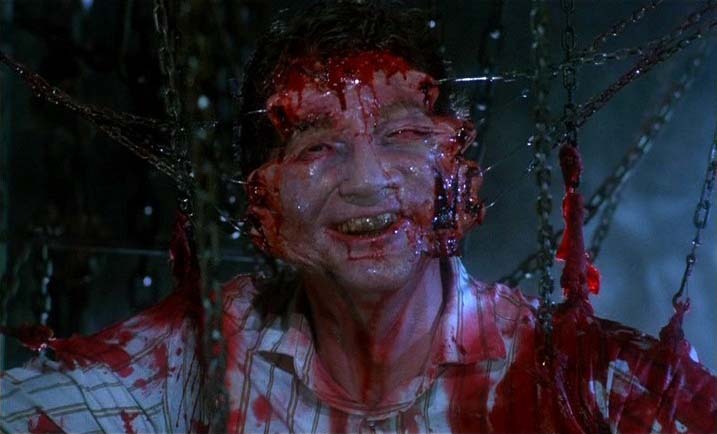
Let's start with something easy. Hellraiser (1987) is a horror film from the late 80s, back when body horror was becoming the height of popularity. It is a staple amongst fans and is culturally recognised as a film with one of the most iconic villains in history (Pinhead). However, if you haven't actually seen Hellraiser, then you may not know that Pinhead is more of a secondary antagonist than the movie's main villain. The main villain, pictured above wearing someone else's skin (I know, pretty grim), is a character named Frank Cotton.

Hellraiser is a film I will always recommend to people who want to watch horror films, whether they're interested in body horror or not, because the foundations of the narrative are based around the culture of sadism and lust, a sort of glamorous and gory representation of greedy human nature. Their victims usually end up disfigured or torn to shreds and that is horror at its finest: sinister, bloody and intriguing. 

The Fly (1986)


The Fly (1986), a remake of Kurt Neumann's 1958 film, is a masterpiece brought to you by none other than the godfather of body horror himself, David Cronenberg. It is a film centred around the  scientist Seth Brundle, who has worked out how to teleport himself from one of his pods to another. A marvellous invention, really, until he teleports with another organic lifeform inside...a fly. 

You can imagine how that goes. The computer can't distinguish the two lifeforms and so blends the DNA together, creating the anti-hero known as Brundlefly. Pictured above is Brundle (played by the wonderful Jeff Goldblum) mid-transformation, as showing Brundlefly would more or less spoil the surprise for any of you who haven't had the pleasure of seeing the film yet.

The Fly is one of many examples of a hybrid genre (sci-fi horror) that depicts body horror in a way that becomes the antithesis of the character, through either mutation, evolution, devolution or otherwise, using plausible science as means to explain their transformations. I would highly recommend it and any of Cronenberg's other films, such as Rabid (1977), Scanners (1981), Videodrome (1983) or Naked Lunch (1991).

Akira (1988)


An unusual addition to the list, mainly due to its format rather than its content, is Akira (1988). This film is popular amongst fans of both body horror and anime due to its graphic depiction of genetic mutation through animation.

The antagonist, Tetsuo (voiced by Nozomu Sasaki), resides in a post-apocalyptic version of Japan, and is drastically altered by the military into a grotesque psychopath. Akira's success, it would seem, is mainly down to its world building: the characters' traumas and evolvement both physically and mentally can be attributed to the fantastical neo-Tokyo setting in which they must learn to adapt to or fight against.

Akira certainly conveys what other body horrors tend to forget, which is the mentality of the victim. Tetsuo is a brash and reckless character for sure, but his mutation is met with anguish, confusion and sadness, something that the audience can empathise with (despite his murderous rampage later on in the plot). Another film similar to Akira would be Tetsuo: The Iron Man (1989), which follows a similar vein of Japanese body horror that blends man and machine but also conveys the character's struggles, humanising them despite their mutations.

Splice (2009)


There are many sci-fi horrors I could add to this list, so I'll stop here with this Canadian-French body horror, one that isn't as well-known as the previous two. 

Splice (2009) follows two geneticists (played by Sarah Polley and Adrien Brody) that are working on splicing the DNA of animals and humans to create a hybrid that can be of medical use. This results in the creation of Dren (pictured above), a humanoid creature with a stinger and retractable wings. But it never goes well for people who "play God" in the movies, now does it? 

Mayhem ensues, though I'll leave the ending out of it for anyone who wishes to give this forgotten gem a go. It makes this list for its excellent use of body horror, in a way that doesn't necessarily show a lot of gore, but definitely shows what could be another step in human evolution (or, at least, evolution gone wrong). 

Black Swan (2010)


Brought to you by a director known for the unsettling and frankly disturbing film Requiem for a Dream (2000), which in its own right incorporates elements of body horror as well, comes Black Swan (2010). A psychological horror directed by Darren Aronofsky, this film truly encapsulates body horror in a contemporary and artistic way.

The plot is centred around ballerina Nina Sayers (played by Natalie Portman) in her strive for perfection, though as she works harder and harder, her place in reality and her grasp of her own sanity begins to fall apart. This film is executed masterfully through the use of Clint Mansell's soundtrack, costume design and special effects and remains one of my favourite examples of body horror. 

Nina's descent into madness is truly a frightening yet thrilling watch, focusing more on an aspect of body horror that orbits around metamorphosis rather than just a general transformation: her character transcends the our reality, just not in the way that it probably should. The Fly, as previously mentioned, would also fit into this category.

Repo! The Genetic Opera (2008)


A format that I would absolutely love to see more of is body horror within unconventional genres, such as musicals. That's essentially what Repo! The Genetic Opera (2008) is: a gothic, science fiction, body horror musical.

Repo! is whimsical yet disturbing in its depiction of a futuristic biotech company profiting off people's need for new organs. It harmonises gore and theatricality quite successfully but it never loses the main essence of body horror, showing the downfall of disfigured main characters like Pavi Largo (played by Kevin Ogilvie, pictured above) and Amber Sweet (played by Paris Hilton). 

Although the plot revolves more around the exploitive nature of capitalism, betrayal amongst family and the element of greed, body horror marries well with choice aspects of this film and does so in both a gratuitous yet artful way. Another musical I would recommend is Sweeney Todd: The Demon Barber of Fleet Street (2007), though that doesn't really fall into the sub-genre of body horror as much as just gothic horror. 

Ichi the Killer (2001)


Those of you who are fans of Japanese horror may or may not have heard of this one, but Ichi the Killer (2001) is a cult classic within the crime horror genre, mainly popularised for its insanely graphic depiction of sadistic torture and quasi-guro elements. 

The plot follows yakuza member Kakihara (played by Tadanobu Asano), a sadomasochist searching for his missing boss. Along the way, he comes across a young man named Ichi (played by Nao Ohmori) who is, essentially, the perfect killing machine: he is perverse, psychotic and able to inflict levels of pain that Kakihara both admires and craves.

This kind of body horror doesn't convey a character's struggles like Akira or The Fly, but presents a character's desires to engage with it. It is almost a romanticism of ultra-violence, popular in other Japanese forms of entertainment such as anime, literature and art. It's certainly a bizarre and downright disturbing film but it uses body horror effectively, and not without reason. One might mistake Ichi the Killer for using unnecessary gratuitous violence, but I would argue that it supports the needs and emotions of the main characters, no matter how grotesque you find them. 

Cannibal Holocaust (1980) and Hostel (2005)


For my last entries on this list, I have grouped together the cult classics Cannibal Holocaust (1980) and Hostel (2005): you might be wondering why, considering both films are completely different in terms of plot and both set in different eras.

However, this is one thing that I wanted to draw attention to when it comes to body horror: it can exist within other sub-genres of horror but that does not make them synonymous. 

Cannibal Holocaust and Hostel are both incredibly gory films, depicting the removal of organs and tampering of human anatomy, however they are both considered part of the 'torture porn' sub-genre of horror as opposed to 'body horror'. Torture porn was popularised in the early 2000s by Eli Roth (director of Hostel) in an ambitious and consequently successful movement to create horror films that showed a correlation between gore and sexualised horror. Roth has stated in many interviews that he was inspired by horror films of the 80s such as Cannibal Holocaust, which he made a homage to called The Green Inferno (2013), a nod to the fictional film featured in Cannibal Holocaust of the same name.

Though featuring elements of body horror, these films are not technically classified as such. I would still recommend them to anyone who would want to branch out into torture porn, though.

Honourable mentions

There are many body horror films, but alas, I can't talk about every single one of them in a singular blog post. I'll list a few more below for anyone who is interested in checking them out, though fair warning, body horror really isn't for horror fans who are squeamish and more prone to watching the psychological or paranormal. Body horror is meant to be gross, and these films certainly are. 

  • Re-Animator (1985)
  • Thinner (1996)
  • Cabin Fever (2002)
  • In My Skin (2002)
  • Slither (2006)
  • Martyrs (2008)
  • Grotesque (2009)
  • The Human Centipede II: Full Sequence (2011)
  • American Mary (2012)
  • Antiviral (2012)
  • Tusk (2014)
  • Bite (2015)
  • Raw (2016)

- K