Popular Posts

Saturday, 25 May 2019

Film Reviews: What's Expected Of Us [The Perfection, 2019]

The Perfection (2019)

[Reader disclaimer: there will be spoilers discussed. This piece also contains material of a sensitive nature].


For a few weeks now, the dark, film-orientated corners of the Twittersphere have been buzzing about an upcoming film to be released on Netflix called The Perfection (2019), a film which I had no interest in besides the fact that Allison Williams was starring in it, an actress who I've been keen to watch ever since witnessing her incredible performance in Get Out (2017).

So, I went into this film totally blind, only knowing of the praise it had received online. I can with 100% clarity tell you now that this film is, apart from Us (2019), the best horror I have seen this year hands down. 

We are introduced to our 'protagonist', Charlotte (played by Williams): a veteran cellist who had to take years out of her career at the cello academy known as Bachoff to care for her sick mother. The film opens with the death of said mother and Charlotte reaching out to her tutor, Anton (played by Steven Weber) to rejoin the world of classical music in any way she could, which leads her to become a supporting judge for a cello competition in Shanghai. 

Here, dear readers, is where I started to fall in love with this film. Charlotte meets Lizzie (played by Logan Browning), Anton's current protege: she exudes a kind of sensual confidence and intimidating albeit erotic vibe, completely contrasting Charlotte's quieter, kinder demeanour. 

The dichotomy of the two characters is the centerpiece of this film. The dynamic between Williams and Browning on screen is spellbinding, something akin to the two heroines in films such as Martyrs (2008) or Black Swan (2010): there's also something to be said about having a strong, queer, WOC character at the forefront of this film, especially considering that it's a horror. I instantly fell in love with my new favourite power couple and that's when things took an unusual but exciting turn.

Admittedly, the first five minutes or so of The Perfection are...messy. It's a little too reliant on exposition and the editing is quirky but sometimes distracting. However, as the narrative progresses with Lizzie and Charlotte teaming up to travel, we see Lizzie's decent into the psychotic: having taken ibuprofen for her hangover, Lizzie begins to throw up violently, experience diarrhea and finally her flesh is seen to be infested with bugs.

At this point, I'm nodding at the television. Ahh, this is a body horror and a psychological thriller, I get it now. No, I didn't get it. Because as soon as the bugs burst through Lizzie's hand, Charlotte hands her a cleaver and the poor bitch chops her hand clean off. Then, the film does something I didn't expect: it rewinds. 

A motif used in other films such as Funny Games (1997), rewinds in films often demonstrate a need to show something prior or to change the narrative: in this case, it was the former, and it shows how Charlotte not only orchestrated Lizzie's madness by drugging her with her dead mother's pills that can cause hallucinations, but through suggestion alone, managed to convince Lizzie to cut off her own hand due to bugs that weren't actually there.

This pivotal scene in the second act (titled "Detour") sets the tone of this film perfectly. It's weird, it's gnarly where it needs to be, and it's clever. And what sent me through a loop is that, whilst in the second act I had deduced that this film was a body horror/thriller, the third act (titled "Home") then conveyed shots and musical scores generic to slasher films. 

Now you're probably thinking, 'well damn, so Charlotte is the antagonist, then'. Wrong again. It's slowly revealed that Anton the music teacher is actually a rapist and a man who is willing to sexually abuse children in order for them to achieve greatness, to achieve "the Perfection". Lizzie, his protege, had been brainwashed to believe that her trauma was invalid, that her suffering made her the brilliant cellist she was: it's not until she cuts off her hand, a deluded but ingenious ploy by Charlotte to bring her back into reality, that the young woman accepts that what Anton did was wrong and not justifiable at all.

This is where the true subgenre of the film surfaces: this isn't just a body horror, a psychological thriller, a slasher...this is a rape-revenge film. And it's a fucking good one. 

What I think is so important about this is how it handles that subject matter. Rape in horror films is a difficult one to analyse and judge, because none of us condone it, but we're still willing to say it's necessary in a horror film to showcase a character getting "stronger": in this case, Lizzie and Charlotte's abused past isn't what defines them, in fact, they're only accepting of that trauma once they're out of the Bachoff headspace of achieving perfection, finally able to see Anton for what he is. 

One of the best scenes in this film is in the fourth act (titled "Duet") in which Anton not only tries to justify his actions by saying that he made them better people but pleads that he is sick and only needs to get help for the situation to be rectified. In reality, this happens far too often to many women, wherein their abuser or rapist either denies what they've done or twist it to have some kind of meaning: in reality, there is no meaning or just cause for rape, and those responsible should be held accountable, no matter what. 

In the end, The Perfection has become a solid favourite from me. I ended up watching it twice in one night because my housemate came home and I begged him to sit and watch it with me. I cannot say enough good things about this film, about how it shows the pressure of an industry hellbent on disciplining its students in inhumane ways, about how rape doesn't empower a woman to be better but only demonstrates how evil men and their backwards logic can be, and about how women in horror films can be queer, people of colour, mentally ill but still survive until the end (and deserve to). 

Overall rating: 9/10

- K

Saturday, 18 May 2019

Film Reviews: I'm A Good Farmer! [The Locals, 2003]

The Locals (2003)

[Reader disclaimer: spoilers will be discussed].


When I was a young, impressionable teen, my neighbour came over to watch horror films with me: I had a huge crush on her at the time and I was eager to see what her taste in gore was like. She brought over a few of her favourites, one being Lake Placid (1999) and one that I'd never heard of before: The Locals (2003).

I recently had to track this New Zealand b-movie down because I couldn't for the life of me remember its name, anybody who had starred in it or what year it came out. And there's probably good reason for that: the director (Greg Page) never went on to direct anything else and none of the actors proceeded to do anything notable, other than Dwayne Cameron who has starred in films with A-list celebrities like Nicolas Cage and Guy Pearce. 

So The Locals focuses on Paul (Cameron) and Grant (Johnny Barker), two "bros" with a banter-filled friendship that conveys an uncharacteristically but welcomed tenderness to their characters. We often see lead men in horror films who are ham-headed and make nonsensical decisions, so it's actually refreshing to see these two interact in a playful yet caring way.

Paul decides to take a shortcut across the countryside for their trip and discovers two girls at the bridge who want the boys to come and party with them. These siren-esque, 80s party girls are the catalysts for what is to unfold but one has to question why they lure the boys into the village in the first place, knowing what we find out as the narrative unravels...but we'll get to that in a minute.

The boys discover that the inhabitants of the countryside are farmers and families in some kind of rural purgatory, forced under the tyrannical reign of Bill (Peter McCauley), a waxy, undead, discount Charles Dance. The man screams intimidation but I found early on (and conclusively towards the end) that he was a very one-dimensional character that could've benefited from being fleshed out a little more. 

There's even a throwaway comment that Martin (Paul Glover) makes halfway through the film about Bill murdering his wife every night, which sounds disturbing as hell: why on earth would he do that, if not for a sadistic streak/psychological trauma? I would've liked to have seen more of it, rather than a lanky old guy standing on his truck of minions and slowly making his way through the film, trying to round up the boys.

I will say that: the pacing of The Locals is all over the place. In some parts, it feels incredibly drawn out, stifling any sense of suspense or urgency. Then it'll do a 180 and crash-course its way through things that I think they could've spent more time exploring: for example, Martin's character goes from cryptid and presenting himself as a helper archetype to deranged lunatic who spends an abnormal amount of time back chatting with a decapitated skull. I could've bought his character being unhinged if it weren't for the fact that, one or two scenes prior, he was totally lucid. 

But what made me want to watch this film again is its ability to make the audience empathise with the characters. After discovering that the countryside people cannot die (in essence, they are ghosts) and will simply rise again (shown in parts through stop motion, which I actually enjoyed, as it was reminiscent of 80s horror e.g. Frank's reanimation in Hellraiser (1987)), it is revealed in the last act that during a tumble Paul takes earlier on in the narrative, he actually died as a result.

This moment is actually quite heartbreaking because, in comparison to other horror films with poignant deaths, there's a real sense of tragedy watching Paul and Grant interact after they discover the former's corpse: Grant doesn't want to lose his best friend but Paul tearfully pleads him to remove his body from the countryside so that he can rest in peace, essentially asking Grant in a subtle way to mercy kill him (again).

The one thing I can say from rewatching The Locals is that, despite it being a very low-budget horror and featuring some questionable writing in places, it feels genuine. I can tell a lot of effort and love went into creating this film and I honestly feel that pays off in the end. I'd recommend giving it a go: it might be a little niche and unheard of but it's definitely a decent watch.

Overall rating: 7/10

- K


Saturday, 11 May 2019

Exploring Villains: Clown Edition

[Reader disclaimer: I would think this is obvious but avoid reading if you suffer from coulrophobia, a.k.a the fear of clowns].

Their giggles haunt your nightmares. Their sadistic, painted grin is slapped on every poster. Clowns, those animatic monsters, have been a trending horror trope in recent years...but are they really that scary?

Origins


So, what is a clown? A guy who slaps white grease-paint on and honks his nose for a living? Well, clowns can be traced back a fair bit, the earliest instance of the word being recorded in the 1500s: they were archetypes often used in Italian comedies (commedia dell'arte), representing the lower class as hilariously stupid and inadequate people. 

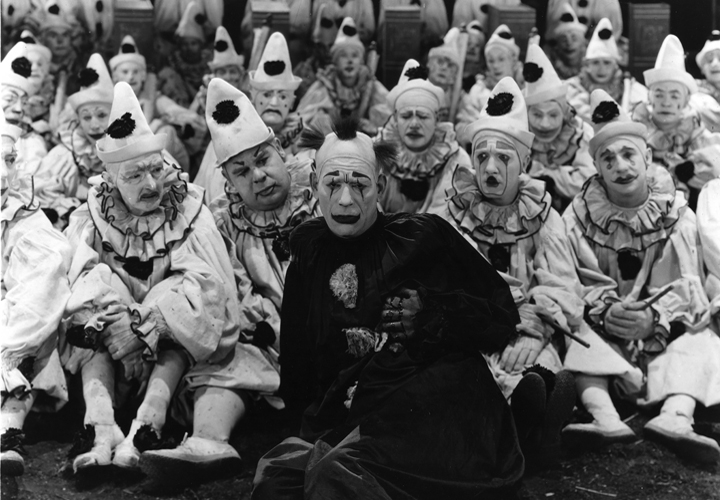
He Who Gets Slapped (1924)
Clowns marry comedy and tragedy harmoniously, truly embodying schadenfreude: when we see a clown spray another in the face with a seltzer bottle, we laugh at their misfortunes because we too can sympathise with the indignation of public humiliation and betrayal from our friends. In essence, the clown character represented the people and became something both recognisable and relatable.

Tragedy into horror


It (1990)

The true frontrunner of clowns in the horror genre is undoubtedly Pennywise, a nightmare-inducing shapeshifter dreamed up by Stephen King in the 1980s. When It (1990) was released, the world was in a frenzy over this killer clown, appalled by the subversion of a children's entertainer being something of a monster.

The reason, I believe, that clowns are considered scary and phobia-worthy is because their nature is to be childlike and innocent, unseeming and jovial. What was once considered a character that we could sympathise with and laugh at has transformed into a character of deception, murderous intent and leaves you with an unwavering sense of unease (much like the trope of children and animals in horror films, which Stephen King has also explored with Pet Sematary (1989) and Cujo (1983)). 

Pennywise, however, stands out because his character is supernatural: It, so to speak, is an alien entity that landed on Earth and rises every 27 years to eat people like animal crackers. The true nature of clowns in horror is that they could be anyone, they could be a neighbour or a friend or just some entertainer hired to ruin your 6-year old's birthday party: they're one of us, masked by makeup and a fake smile.

Ranked: Iconic Clowns


So, who is the best horror clown? Well, I've listed a few of my favourites below with their name, origin movie and why (in my opinion) they cause such a visceral reaction from their intended audiences.

It (2017)

Pennywise

Played by: Bill Skarsgård
Who is he?: A cosmic entity who came to earth and rises every 27 years to feed on humans
Scare rating: 7/10. His 1990 incarnation (famously played by Tim Curry) was too whimsical and likable to be scary and I think that, despite the enlarged forehead, Skarsgård is also pretty simplistic until he bears his teeth. The wandering eyes is absolutely creepy, though.

House of 1000 Corpses (2003)

Captain Spaulding

Played by: Sid Haig
Who is he?: The owner of Captain Spaulding's Museum of Monsters and Madmen, a lover of fried chicken and murdering innocent people, and a lovable asshole.
Scare rating: 5/10. In general, Spaulding's appearance isn't hugely threatening, at least not as much as the gun he wields or the verbally abusive things he says. His look is iconic, however, and I consider him to be my favourite horror clown.

Zombieland (2009)

Clown Zombie

Played by: Derek Graf
Who is he?: Simply referred to in the credits as 'Clown Zombie', this absolute mad-lad was never actually named in the film, so your guess is as good as mine!
Scare rating: 8/10. Besides the eye-watering, gaudy outfit, I think it's safe to assume that anyone would be terrified of this guy. He's a clown and he's an undead cannibal: you do the math.

Gacy (2003)

Pogo

Played by: Mark Holton
Who is he?: Unfortunately, this one is based in reality. Pogo represents the real life serial killer John Wayne Gacy, who kidnapped and murdered young men in the 70s.
Scare rating: 6/10. On appearance alone, Pogo is more so grotesque than he is scary, but there's something unnerving about the bold colours across his mouth and eyes and the fact that he was modelled after a man who committed truly disturbing crimes.

Killer Klowns from Outer Space (1988)

Klown Performers

Played by: Various people
Who are they?: As the title suggests, these are "klowns", which are basically aliens who look like interpretative versions of clowns. 
Scare rating: 9/10. Look at them. These things look absolutely insane, like caricatures of clowns on acid or Mr Blobby wearing a skin suit. The entire film is based on how people don't take them seriously because of how ridiculous they look and yet they're secretly dangerous, which I think is complete horseshit: if I saw these things coming, I'd run a mile in the opposite direction. 

Terrifier (2016)

Art

Played by: David Howard Thornton
Who is he?: Art the Clown is an enigmatic serial killer who seemingly possesses supernatural abilities and derives enjoyment from torturing his victims
Scare rating: 8/10. Art's character is, stylistically speaking, incredibly innovative and intimidating: modelled on the clown archetype of 'Pierrot', he dons a monochromatic look and a smile that would make Conrad Veidt proud. I think what makes Art perfect for horror is his silent demeanour: his lack of empathy and communication makes for a wonderfully demonic portrayal of an unhinged human being, masquerading as a clown blanc. 

Honourable mentions

Twisty (John Carroll Lynch) - American Horror Story (2011-)
Stitches (Ross Noble) - Stitches (2012)
Frowny (Eli Roth) - Clown (2014)
Gwynplaine (Conrad Veidt) - The Man Who Laughs (1928)

Clown pandemic


You might now be wondering if I am afraid of clowns and, truthfully, I have to say I'm not. I appreciate why people are afraid of them but to me, they're just performers in eccentric makeup: the only thing I find horrific about them is their constant need for audience participation...no thanks.

So, are clowns meant to be feared? Are they really that scary? I suppose that isn't for me to say but my unsolicited opinion is that there isn't anything to be afraid of. Coulrophobia, unless instigated by PTSD/severe trauma, is an irrational fear: that isn't to invalidate anybody's phobia of clowns but it is to say that there isn't a definitive reason as to why clowns are scary.

The Man Who Laughs (1928)

Many people cite Pennywise as the source of clown discomfort, as he became a popular figure in horror culture: others derive their fear from monsters such as John Wayne Gacy, who wasn't a fictional character but a real person in clown makeup, luring people into a false sense of security and butchering them. I've even heard of someone on Reddit who fears clowns due to the Joker character from the DC franchise.

It's interesting to me that such an innocent and enjoyable character has been subverted to be a thing of nightmares, a collective posterboy for perverse and chaotic death. I imagine the trope of 'evil clown' will wear out its welcome eventually: I wouldn't mind seeing a horror film where the clown is the hero/sidekick, just to subvert the subversion for once.

- K

Saturday, 27 April 2019

The Struggles of Horror Movie Fatigue

Film fads have a sell-by-date and, like every other form of media, we grow tired of them if they're exceeded. Depending on your genre, this can often be referred to as "x fatigue": in simple terms, the state in which a genre is repeatedly beating a dead horse.

Jeremy Jahns, a YouTuber film critic who I wholeheartedly admire, recently reviewed The Curse of La Llorona (2019) and claimed that we may indeed be suffering from "horror fatigue" with this era of horror we are currently experiencing.

The Occult cycle

As with many film fads, they tend to circulate every decade or so in different forms. When I refer to the occult cycle, I mean specifically the time where horror movies sprung up in the late 60s to the early 80s, horror movies we love and respect in this day and age such as Rosemary's Baby (1968), The Exorcist (1973), The Omen (1976) and The Amityville Horror (1979). 

Cycles come and go. After the occult cycle, we had the era of 'torture porn', pioneered by directors such as James Wan with Saw (2004) and Eli Roth with Hostel (2005): we charter through these gore-infested waters every few years or so because audiences grow tired of seeing the same thing over and over again, especially if the quality of such starts slipping.

The Exorcist (1973)

There are (in my opinion) two/three types of fans:

1) The franchise fanboys. These fans are ride or die for their favourite film series, whether it be Harry Potter, Lord of the Rings, Fast and Furious, Final Destination etc etc. They will go and see these films regardless of whether they are good or not and they are the ones that make studios a lot of money. I suppose a contemporary example of such would be Marvel who, despite releasing some films that bombed (I use that term loosely) at the box office like Thor: The Dark World (2013), will always bring fans in.

2) The horror purists. This kind of fan is at the other end of the audience spectrum, increasingly difficult to please by today's standards of film making. They flock to arthouse, abstract and innovative horror, often casting their net further than the Western region of the world. 

3) The indifferent. I feel as though this is the category I fit into: I love horror that challenges the lazy formula we've fallen into in recent years but I also appreciate and enjoy franchises. I think both can co-exist, as long as people understand that franchises and innovative horror can be enjoyed separately. 

The current cycle

So, how is our current cycle relevant to this discussion? Well, what the horror genre is currently experiencing can arguably be described as a resurgence of the 70s/80s occult cycle, popularised back in the late noughties by Dead Silence (2007). Similarly to the superhero genre, horror revamped the way we look at the supernatural, paying more attention to jump scares, gothic elements and a rebranding of 'the big baddie'.

Think of the horror films from 2010 to 2013 and how iconic their villains are: Bughuul from Sinister (2012), the Lipstick-Face demon from the Insidious (2010-2018) franchise, the various items from The Conjuring (2013). All of these films were easily marketed because of their distinctive villain but they also preyed on the audience's insecurities, from demonic child possession to vengeful ghosts, aspects prevalent in the occult cycle.

The Conjuring (2013)

The Conjuring was definitely (in my opinion) the catalyst for the new occult movement: raking in $41m in its opening weekend, this film became a modern classic for many horror fans, making Wan's most popular film since Insidious. The occult cycle then took a breather for a couple of years until Wan returned in 2016 for a sequel, which many praised as being surprisingly better than the first.

Horror movie fatigue

Therein lies the issue. After the release of The Conjuring 2 (2016), everybody jumped on the bandwagon. Studios noted Wan's success and wanted to replicate that tenfold in order to increase profits, thus began the endless shit-stream of films that tried to hash the occult cycle formula out without paying any real attention to what made those films good in the first place: from what I can gather, it looks as though the studios thought if they created an iconic baddie and slapped it on the posters, then people would flock to the cinemas to see it.

And they did. The Nun (2018), regarded by critics as a complete flop and disservice to the Conjuring franchise, still managed to be the franchise's best opening weekend with $52m. But it became clear very quickly that either people loved The Nun because it's a franchise film or completely hated it due to the fact that it's...well, it's bad. 

Kevin Maher from The Times commented that "the scares are non-existent" and that "being pulled backwards along the floor in a darkened room hasn't been scary since Insidious in 2010". The Nun is a lot of cheap tactics and poorly performed dialogue wrapped up with a fantastically scary mascot on top, but people still saw it, because that's the only thing the mainstream industry want to offer at the moment.

The Nun (2018)

2016 ushered in the era of horror flops. After the success that Wan had brought in, the cash-grab for the occult cycle began, leading to films like Ouija: Origin of Evil (2016), Friend Request (2016), Annabelle: Creation (2017), Veronica (2017), Slender Man (2018) and recently with The Curse of La Llorona (2019). 

All of these films are somewhat commercially successful but that's purely due to the franchise fanboys. In essence, these films reflect lazy writing, cheap jumpscares, abhorrent use of sfx and a damning lack of forethought. They rely on fanbases to carry them because, at the end of the day, they're bad movies. Not just bad horror movies, but bad movies. 

Moving forward

What grinds my gears about horror movie fatigue is that people then refrain from seeking out horror as much, as if to suggest that there aren't any good horrors currently milling about in the cinesphere. I think of films like The Nun and then glance over lovingly at my copies of Get Out (2017) and Hereditary (2018) and wonder why people can't create movies with the same passion and care as Jordan Peele or Ari Aster. 

"Yeah but those kind of indie, socio-political horror films don't make money!" 

Absolute shite, my good sir. Get Out scored $33m and Hereditary had $13m to their names in the opening weekends: sure, that's not as much as films like The Conjuring but these films now have large followings because a) they know that those respective movies are examples of exemplary horror and b) they know they won't turn into cash-grab franchises. 

Insidious (2010)

Let's put it this way: Get Out performed well for an opening weekend but Peele's second film, Us (2019), more than doubled that on its opening weekend with $71m, making it the third-biggest R-rated horror opening of all time. And he didn't achieve that through tacky gimmicks: he did that by putting care and effort into his films, demonstrated by Get Out only a few years prior.

I'll end on a piece of unsolicited advice. Money makes the world go round, sure, but your franchise will die a sad death if that's your only motivation. It seems as if today's directors have forgotten what happened to 80s horror once they tried to pile up sequels: go and watch Hellraiser: Revelations (2011) and then get back to me.

- K


Saturday, 13 April 2019

Film Reviews: A Love Letter to Raimi [Wither, 2012]

Wither (2012)

[Reader disclaimer: spoilers will be discussed].


This hidden gem of a film, lovingly reviewed by Fearnet network as "a legitimate love letter to The Evil Dead", is a Swedish horror from 2012 that follows the stereotypical group of young adults as they venture into the woods for a weekend of fun, sex and unexplained, supernatural horror. 

Wither (2012) immediately captured my attention from the get-go, subverting the generic and gendered tropes of the characters by swapping them; one of our main antagonists, Ida (played by Lisa Henni) is established as the dominant one in her relationship with Albin (played by Patrik Berg-Almkvisth). It had a promising start because, despite its cliches, Wither effectively coerced me into sympathising/liking the characters, a difficult feat for horror films nowadays. 

The other thing that ended up surprising me is the look of this film. For a b-movie, Wither has some sensational cinematography, cleverly framed shots and an enticing soundtrack. I found myself stopping at various points of the runtime to sit and appreciate just how nice everything looked: it had a great balance of realistic gore and aesthetically pleasing mise-en-scѐne.

However, with all films, it has its flaws: for me, this lies in the film's lack of narrative closure.
Despite portraying Ida as a strong character, one that you would presume to be the 'final girl' of the film, she also falls victim to the supernatural curse that haunts their home away from home. This leaves us in the last act with Albin having to mercy-kill her and, consequently, leaving him to be the last man standing: I don't think this works particularly well because although this demonstrates Albin finally facing his fears, it doesn't demonstrate what kind of man he is. All the way through the narrative, we grow to like and understand the motives behind most of the characters, but you never become too invested in Albin, therefore his 'victory' in surviving falls flat. 

This was also an issue with Gunnar (played by Johannes Brost), the helper/donor of the story. Gunnar commits suicide shortly before the last act of the film after being infected by the supernatural evil, a scene which hams up the emotive score and shows us flashbacks of his life before everything went to hell. But Gunnar is never fully explored as a character, limiting his life experience to a few flashbacks and a heavily-expositional monologue in a few scenes prior, meaning that although the film wants me to empathise with his death, I am literally incapable of doing so. 

Lastly, the antagonist of the film. The reason Wither is likened to The Evil Dead (1981) is because it borrows the formula of kids in a cabin, plagued by a supernatural monster which possesses them one by one, forcing them to turn and murder each other: this starts with Marie (played by Jessica Blomkvist) finding the demonic entity in the basement and becoming the first victim.

However, characters like Linnea (played by Amanda Renberg) and Ida become loose ends in the film's conclusion: we never see Linnea actually die on screen and it's only implied that Ida has died after being crushed. So, even though the entity is officially bumped off, we don't know whether the others are still alive or possessed, making the defeat of the antagonist slightly inconsequential and open to interpretation. I was left feeling like I had a lack of closure to the film, and I don't think that was a deliberate tactic to leave space for a sequel. 

A lot of online reviews berate this film for plagiarism but I disagree: there certainly is a difference between stealing and giving tribute, and I honestly believe this film is the latter, paying homage to the cheesy greatness of 80s slasher flicks. It had its flaws narrative-wise, but I had fun watching Wither, and now it certainly sits on my list of go-to horrors for when I have friends over.

Overall rating: 7/10

- K

Wednesday, 27 March 2019

What's Happened to the Cinema Experience?

My friend and I went to see Us (2019) last week, and while I'd love to sit here and discuss how good Jordan Peele's second feature film is (don't worry, I'll write a review soon), I found myself waking up this morning still incensed from the experience I had at the cinema itself.

"Back in my day!"

I know, nobody likes hearing people hark on about the "good old days" when things were different to how they are now, and why that somehow requires a 20-minute lecture about the abhorrent state of society. But hear me out, because to understand my gripes with the current cinema experience, we have to consider context.

When I was younger, one of the first film's I ever went to see was Pirates of the Caribbean: The Curse of the Black Pearl (2003). I nearly shat my pants when the undead monkey popped up on screen, I cheered through Captain Jack's heroics and laughed at his quips. And aside from the film being everything 8-year old me could hope for, I remember loving the whole experience of visiting my local cinema. 

Geoffrey Rush and co. in Pirates of the Caribbean: The Curse of the Black Pearl (2003)


Pick-and-mix on tap. Pop music in the foyer. Families laughing and crying at films together. It was a formative part of my childhood to go to a cinema because now I am so in love with films that it's ridiculous: I don't think I would've turned out that way had I not been taken to see things on the big screen. 

Now, an important aspect of any cinema visit is snacks. As a kid, we bought things from the concession stand: they were pricey, yes, but actual film tickets cost less than a fiver, so it was a luxury to splurge a bit on that extra large bag of popcorn or gorge yourself on too many chocolate M&Ms. It wasn't a necessity but it was just something you did to add to the experience.

Many of you who still go the cinema will know this, and I will explore it further in a second, but unless you only go the cinema occasionally, frequent movie-goers never buy anything from the concession stands anymore.

Why?

Well, I'd rather not have to take out a fucking loan to buy a small popcorn or sell my organs for a Coke.

Capitalist utopia

Let's fast forward back to the night in question. My friend and I enter the cinema, elated to see Us: I have personally been waiting well over a year to see this film and I've waited nearly a month to actually go because I pre-booked (yes, I was that damn excited).

Because I'd been gifted a voucher for my birthday, I had a little bit to spend of snacks: a rarity at this point because, as aforementioned, you don't buy food at cinemas anymore. The price of food is extortionate, to the point where people (including myself) often buy snacks in bulk from local corner shops before ever entering the cinema. 

Average annual cinema ticket price in the UK from 2000-2017 (in GBP)

You smuggle in your 99p chocolate to enjoy alone or with others because, seeing as cinema tickets now can cost anywhere up to £8 in the UK according to statistics dated in 2017 (though my local cinema charges up to £14 for an adult ticket, which is double the average), snacks are just not feasible. It's not stingy to turn around and refuse to pay £4.35 for a small popcorn when you can buy a bag from your local Tesco for a quid: that's called using your common sense.

Anyway, my friend and I decide to indulge ourselves in buying pick-and-mix: you're never too old for slightly chalky sweets that may or may not have been manhandled by a curious toddler beforehand. We chuck a couple of the ol' favourites in (I personally like chocolate mice, raisins and Smarties) and then go over to the register. To my absolute horror, she rings the bill up at £10. For pick-and-mix. 

I give a nervous chuckle and just pay what I can off my voucher card and then pay the rest by debit but my god, what kind of absolute madman must you be to price your sweets that high? Who on earth would pay for that? I know damn well my parents never would have bought me a bag of glorified corner shop sweets at a cinema if it meant costing them an arm and a leg to do so.

Cinema etiquette

So, at this point, my bank account is weeping in the background and I'm slightly disgruntled. But I acknowledge that this happens, that the average cinema is designed for #consumeristlife, so spending money is going to inevitably happen (even if it means throwing away £10 on fucking pick-and-mix).

On to the best part: watching the film. 

There's an unspoken rule, I believe, when it comes to seeing a film in public: be respectful of the audience. That means if you're watching something suspenseful, don't bring in bags of food that make a lot of noise. If you're seeing something subtitled (or, in my opinion, any film, subtitled or not), don't talk during the runtime. And the absolute obvious one: don't use your bloody phones. Don't take them out. Don't even have them on, unless you have to in case of emergencies. 

"Maybe. Maybe not. Maybe go fuck yourself." - The Departed (2006)

When we went to see Us, not only did people rustle behind us with their popcorn and crisps and whatnot, not only did people talk over the film when there were suspenseful moments and important, expositional dialogue, but they committed what I consider to be the worst of cinema sins: a couple of people were on their phones.

I watched one girl scrolling through her Insta feed and thought, "why the fuck are you here?"
Who pays this amount of money on a film and accompanying snacks to just...not watch the film? If you wanted to scroll through social media at your leisure and half-ass watch something, do it at home where you're not bothering anybody else. And I'm not trying to be some kind of elitist when it comes to cinema experiences, I just believe that it's "cinema etiquette".

I spoke to my best friend and fellow cinephile, Lili (@cinemellon) on her experiences with outlandish and rude cinema patrons, and she very kindly told me her experience when it came to seeing Hereditary (2018):

"When the film began, everything in the screen was fine, and during the first 20 minutes, everyone seemed to share the same sense of quiet tension with occasional nervous laughs. 

However, as the film went on, younger audience members started laughing at serious moments, talking loudly over dialogue, making jokes and making disruptive sounds. All of this was extremely distracting and I was completely thrown off. I was getting more and more angry and wasn't able to enjoy the film at all, no matter how hard I tried to focus.

I loved what I was seeing on screen but, after a while, I was just overcome by rage and sadness, wishing I would have waited until the DVD release.

Don't get me wrong, laughter alone would have been perfectly fine, but people were actively making fun of the film and ignoring the possibility that some people might actually want to pay attention and enjoy the experience they paid almost £15.

As soon as the credits rolled, I stood up and stormed the hell out of there."

Why bother, then?

The question you might now be asking is, "well why do you even go to the cinema then?"

Good question. The answer is simple: I don't.

And that's absolutely not to discourage anybody else from going because when I used to go to the cinema, I would stroll through those popcorn-scented corridors with my rose-tinted glasses firmly wedged onto my face, and I don't see any reason why other people shouldn't experience that.

My argument here is that...well, I don't get that experience anymore. Cinema has become so deeply imbedded in capitalism and profiting off their audience rather than setting up the perfect fairytale-esque experience that most people deeply crave when they go to see a film. 

There has been a debate recently on whether Roma (2018) should have ever qualified for being at the Oscars, considering it's a Netflix film: of course it does, it's a film that elicits strong, powerful emotions, directed by (in my opinion) one of the most visionary and kind directors of our generation. Of course it has a place at the Oscars, an award show that celebrates cinema, people. And a damn sight more filmgoers were able to see it because they were able to access Roma in the comfort of their homes for a considerably cheaper fee.

I understand that money has to factor into filmmaking: we wouldn't have films otherwise. But when did cinemas start to lose that magical edge? When did they forget why people came to see films at their establishments in the first place?

Because, as it stands, I only ever visit cinemas around once or twice a year. And it's not for the popcorn. 

- K

Saturday, 16 March 2019

Art vs Artist: Can We Separate Entertainment From Those Who Tainted It?

[Reader disclaimer: this piece contains material of a sensitive nature].


Roman Polanski on the set of Rosemary's Baby (1968)

Following the controversies surrounding Leaving Neverland (2019), wherein the documentary follows Michael Jackson's child abuse allegations, and recent war between actors Amber Heard and Johnny Depp (which has now alluded to both being victims and perpetrators of domestic violence), there has been a question and thought on everyone's mind: are we still allowed to like the films/music they've made?

I've talked with people in my life about this, some of which argue that you are indeed able to seperate a problematic person from their format, others that disagree and say that by supporting someone's film/song/product, you are complicit in supporting that artist as a person. 

For me, I find this to be a difficult question to answer. On the one hand, one person's actions should not condemn a whole film: one actor does not equate to an entire movie, there are directors, cinematographers, producers, camera technicians, special effects and makeup teams...the list is endless. They were not responsible for a leading man/woman's faults. 

However, that being said, I recently watched Moon (2009) for a review, and despite him not even appearing on screen, the sound of Kevin Spacey's voice made me feel incredibly ill. It didn't detract from the whole experience of watching the film but it certainly made me uneasy just hearing him be in it.

Stanley Kubrick and Shelley Duvall on set of The Shining (1980)

We as a society are not unused to hearing people in the film industry attempting to veil their sins off-screen, unfortunately. One of the biggest directors in Hollywood, and one of the most problematic ones, was Stanley Kubrick, who you will undoubtedly know as the man who directed such iconic films like The Shining (1980), 2001: A Space Odyssey (1968) and A Clockwork Orange (1971).

His talents made for some of the most intriguing, awe-inspiring scenes we have ever seen in cinema, and I think that goes without question. But if we strip away his art, if we look at who he was as a person, Kubrick was a self-aggrandising bully on-set, an artist with an inflated ego and a short temper.

He is renowned for his mistreatment of leading actress, Shelley Duvall, who went on to have many mental breakdowns and was as recently as 2016 seen to be suffering from severe mental illness: that is not to say that I'm accusing Kubrick of inflicting Duvall with that but it certainly seems that his influence back in the early 80s left Duvall with arguably severe bouts of PTSD. That is, of course, just speculation...but I digress.

Victor Salva on set of Jeepers Creepers (2001)

Another director who has faced controversy is Victor Salva, which I wasn't aware of until recently (a few years back, I'd say) had been convicted of molesting a 12-year old boy and possessing child pornography.

Insane, right? Surely, then, he was blacklisted from ever making films again.

Wrong.

In fact, after a five year hiatus, Salva went back to being a fulltime film director, his latest project being as recent as Jeepers Creepers 3 in 2017. When I discovered his previous convictions, I was absolutely appalled to know that he was still praised in the inner circles of horror fandoms and still given the time of day to create anything. Then again, people still love Roman Polanski, and he's a straight-up rapist. 

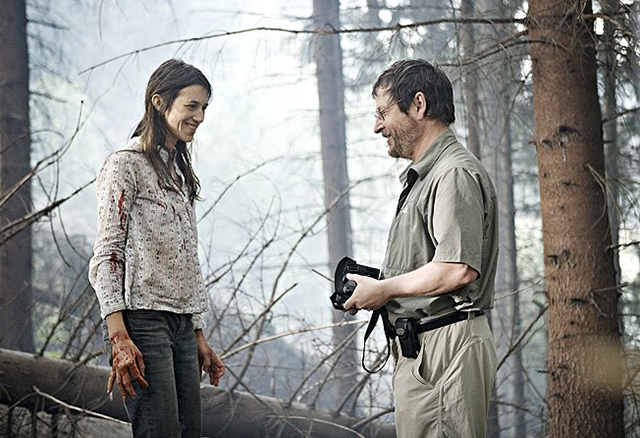
Charlotte Gainsbourg and Lars Von Trier on set of Antichrist (2009)

Tobe Hooper. Lars Von Trier. Quentin Tarantino. Ruggero Deodato. 

The list is endless. And these are just horror/thriller directors, I'm not even mentioning the countless others that have committed pretty horrendous crimes within Hollywood.

So why do we still watch their films? Should we watch their films? 

From what I can gather, it's largely down to personal preference. Society claims to maintain a moral compass when it comes to this sort of thing, ready to blow the whistle on anybody willing to step out of line, but if we're being entirely honest here, some of us just...let things slide. 

It's hard, I guess, for some people to accept that their heroes or idols are problematic, indeed, sometimes even as far as dangerous, because we crave what they create. As a consumerist species, we thrive on new film releases, glue ourselves to the TV for the next episode, tune in to the radio or Spotify to hear the new top 40 because entertainment is made for everybody to enjoy. 

But recently I've found myself noticing that a lot of people make excuses to keep that influx of entertainment going, at a point where they will disregard fact and evidence of wrongdoings to ensure that those creative products keep coming out.

Ruggero Deodato on set of Cannibal Holocaust (1980)

This is, of course, not to shame anybody. I am guilty of this myself: whilst I refuse to buy it because I don't want to support distribution of it, I still enjoy Cannibal Holocaust (1980). It's a horror film. It was made to be consumed and enjoyed. Of course I can't stand that they murdered and filmed animals for the sake of their "art" but whether I watch it or not, it's still out there and it's still watched by others.

I think that we've come to a point in time where if we see behaviour that is unacceptable, regardless of your status, you need to be removed from the entertainment industry pending investigation. Kevin Spacey was no exception. Neither was Bryan Singer. Yet we allowed people like Johnny Depp (yes, I know that's a complicated one right now, don't @ me) and Chris Pratt to continue their work because...well...people love them and think they're pretty.

It's so strange to me that audiences will come to the defense of a genuinely shitty person, claiming that "I know he/she would never do that!" as if they have any real impact of their lives as celebrities. You don't know these people and, chances are, they don't know you: they're paid to dazzle you with their acting abilities, they're paid to entertain. Funnily enough, I don't want to pay to see a rapist or a paedophile or an abuser act for me because I'd rather see them rot in prison.

Gunnar Hansen and Tobe Cooper on set of Texas Chainsaw Massacre (1974)

So, what do you think? Can we separate art from their artists? Are we allowed to enjoy the creative product without praising the one who makes it? Or do we disregard art if it's created by someone who does not respect the law or the moral boundaries that humanity has set in place?

- K