Popular Posts

Saturday, 22 June 2019

Sex, Demons & Visibility: The DemonHuntr Series

"Make it gayer" is a common in-joke within my close circles when it comes to television and film. For every token gay, there's a hundred straight characters, which gets a bit boring after a while: there's only so many cis-het people I can see on-screen before I decide to switch over to something better, like Shadowhunters (2016-2019). 

So it was as a surprise when I came across the Twitter for DemonHuntr, a queer-centric series which is currently trying to find its footing and take off. When I read the premise of the show, simply a "diverse group of queer friends who hunt down demons" and "sometimes sleep with them", I had a hunch that this was a show for me.

The Heteronormative Paradigm


So, what exactly is this series and why haven't you heard of it? In essence, DemonHuntr is focused on a friendship between two men, one gay and one straight, who play the roles of mediums: they use the "DemonHuntr app" (hence the name) and go on to solve mysteries and fight the supernatural. 

What makes this series different, it seems, is not only its incorporation of technology as opposed to magic (which we can see in its contemporaries e.g. Buffy the Vampire Slayer, Shadowhunters and Supernatural) but it's also incredibly diverse in terms of characters.

One of DemonHuntr's main driving points is that it "brings queerness and diversity to the forefront", including a broad range of races, genders and sexualities. This is almost unprecedented, as the industry currently stands, because most horror/supernatural shows are founded in heterosexuality and white privilege (don't @ me, you know that's true). 

What Tim O'Leary, creator of the show, intends to do is give everybody "a seat at the table", a mindset that I wish more showrunners and producers would have: if more people were open-minded to being diverse, we'd have more shows that make us as a community feel validated. 

Some initial skepticism


Eragon (2006)

However, despite my excitement for this project, I had a few concerns. Firstly, there will undoubtedly be some bigoted cis-het people who are going to throw a tantrum when they find out that they don't make up the majority of people shown on-screen: I know that's completely stupid but I can't ignore the fact that, whilst I don't think they need anymore representation in the horror/fantasy genre as it is, it would be exclusion if the series flat-out rejected the idea of including them at all.

Secondly, the range of diversity is wonderful, but DemonHuntr could easily fall into one of those productions that accidentally pigeonholes characters into bland, unimaginative stereotypes, which would further hinder LGBTQ+ representation instead of celebrating it. 

So, I had a correspondence with the show's aforementioned writer/creator, Tim, to iron out these details.

"Straight, white men aren't excluded from DemonHuntr," he explains, "because no one is excluded from DemonHuntr. Our show takes place in a world where absolutely everyone is accepted for who they are."

"We're not saying LGBTQIA people can come to the party and straight people can't - we're saying everyone can come to the party."

Following on from this, Tim responds to the idea of pigeonholing characters into stereotypes by stating that "none of [the] characters leaned too heavily on them" and that the reasoning behind having the main focus on Asian-American, Latinx and African-American people was because he hadn't seen them shown properly on TV before (at least not all together), "which is why [he] wanted to write them".

Artistic license


Forbidden (2018)

Something that deeply fascinated me about this response was "everyone is accepted for who they are". Within LGBTQ+ culture, we're often represented in the media as having undergone some kind of trauma or backlash to be in the stable (or in some cases unstable) position that we find ourselves in at the end of the narrative, but for DemonHuntr, it seems this alternate universe is far more accepting than our current one. 

When asked about whether the queer characters we'd see on-screen would deal with the hardships of being openly queer, Tim responded, "the short answer is no - none of the characters struggle with anything having to do with their sexual identity or how that fits into the greater world."

It reminded me a lot of Todrick Hall's visual album, Forbidden (2018), and how homosexuality took place in an alternate version of our world that saw it as the foundation of our society: being queer was normalised (to a degree). 

Tim explains that there will be scenes in which we see characters defining themselves but that "no judgment" is attached to that because there's shouldn't be anything inherently bad about being open about yourself. He goes on to say, "[...] there is absolutely still a place for stories about people coming out, about dealing with the hardship related to sexuality, and the struggle over identity. The need for those stories hasn't gone away, and I'd be lying if I said I didn't tear up every time I see a film like that."

But Tim and his team are doing something that I think every queer person can resonate with: he's trying to produce something that is aspirational, that omits discrimination and the ugliness of homophobia, racism and queer erasure. He defines his characterisation of the people in the show as writing protagonists "who are queer without their queerness being their defining trait", a sentiment that mirrors my own (as you may have seen from the queer-coding article I did a few weeks ago). 

This will be a show for everyone that promises not only representation but, more importantly, acceptance. 

Moving forward


As of right now, DemonHuntr is crowdfunding to get the project up and running into production stages: they've amassed a whopping $10,000 already in less than a week, a clear thumbs up for getting it well on its way to realising its potential. 

You can help them out by donating to their page and getting them to their goal of 36k, which goes towards cast wages, production, special effects and all sorts of things to get everything moving (a breakdown of costs are listed on the site). 

If you'd like to keep updated on how the show is progressing, you can follow their socials as listed below. I'd like to thank Tim O'Leary and also Robert Rice (producer and actor on the show) for being so kind and letting me have a chat with them about their passion project. 

Social medias:
- K

Saturday, 15 June 2019

Queer Bodies in Horror: Why Gendered Reveals Are Harmful

[Reader disclaimer: spoilers will be discussed. This piece also contains material of a sensitive nature].


Insidious: Chapter 2 (2013)

Something that has really been playing on my mind lately is a specific horror trope that has been used in films for years and is regarded as one of the most well renowned plot twists in cinema: the gender reveal. You'll undoubtedly know this from films like Psycho (1960) but you may not have ever stopped to wonder why this trope is harmful to the LGBTQ+ community. Not until now, anyway.

The subversion of gender as a trope, sometimes referred to as the "gender bender", is where a film features a character that can be transgender, non-binary or cisgender and the plot twist revolves around their "true" identity being revealed to the audience.

In Silence of the Lambs (1991), Buffalo Bill is described as a "transsexual" and is motivated to murder his female victims under the pretext that he was being rejected for gender reassignment surgery.

In Cassadaga (2011), Christian Burton is berated by his mother for wearing dresses and playing with dolls, and consequently castrates himself, leading him to lead a traumatised adult life wherein he murders women and forms them into real-life marionettes. 

In Insidious: Chapter 2, the ghastly apparition of the Bride in Black (also known as Marilyn) is seen to be raised as a girl and psychologically abused by his mother, then proceeds to castrate himself and later commit suicide. He spends his adult years murdering women in the iconic funeral dress and then haunts the living after his death.

This list could go on (and I'd rather not) but my main point is that we see this trope in a lot of places and don't usually think much of it. Why should we? It's just a plot twist, right?

The Problem with Sleepaway Camp (1983)


Sleepaway Camp (1983)

There is, of course, one particular horror film that is famous for this trope: Sleepaway Camp (1983). What has now solidified itself in modern culture as an iconic film, Sleepaway Camp dons the gender subversion plot twist like a big, shiny medal, revealing at the end that Angela (played by Felissa Rose) is in fact Peter, raised by his "eccentric" (albeit clearly mentally ill) aunt to be a girl. 

The camera pans away, showing Angela standing there stark-naked beside the body of her camp sweetheart, Paul (played by Christopher Collet), wielding a knife, an unnerving expression on her face. She lets out a feral, scratchy sound and, as we move from close-up to wide shot, we see that Angela has a penis.

Arguments have, of course, been made for why this ending is so memorable and unforgivingly creepy. Perhaps it is the juxtaposition of scenery, standing by a tranquil lake late at night, lulling the audience into a false sense of security before bludgeoning them over the head with the truth. Perhaps it's the frozen expression on her face, somewhere between childlike euphoria and murderous intent. Perhaps, as some people on Reddit pointed out, it's the uncanny valley effect that is given when shots of Felissa Rose are interchanged with the body double wearing an unnervingly realistic mask of the actress. Or perhaps it's a combination of all three.

I've read articles that claim that the penis reveal is not what makes this ending shocking. Some critics claim it's the reveal that Angela (who is Peter) has been assuming the identity of her dead sister the entire time, or that the trauma that they experienced (seeing their loved ones killed but also the addition of seeing their supposedly depraved father in bed with another man) is what lead Angela on her murderous rampage within the camp.

But I disagree with this entirely because you can tell that the film wants you to go "oh my god, she's a boy!" which, incidentally, is an actual quote from the end of Sleepaway Camp. No, there are a couple reasons as to why the ending of this film is so disturbing, but not for the reasons you often see discussed online.

Cassadaga (2011)

Firstly, Angela's character is 14 years old. The fact that they objectify her at the end by showing off her prepubescent body and genitals is not only alarmingly perverse but begs the question as to why more people haven't spoken out about it. 

As a queer person over the age of 20, I felt repulsed to be acting as the observer, and yet I have not seen other critics point this out. This might be due to the fact that the majority of them are cisgender men who see no apparent reason to see this as a cause for concern, but the age thing is definitely creepy, no matter which perspective you take.

Secondly, I fail to understand what response the film wanted me to have. Was I meant to be afraid? Disgusted? Creeped out? Angela's character undergoes trauma at the hands of Mary Ann (played by Alyson Mord) when she accidentally murders Angela's family and has her identity forcibly removed by her aunt Martha (played by Desiree Gould) before she even gets to the damn camp. At this point, I can't help but sympathise with the character, which I doubt was the film's intention for me as a viewer. 

You might now argue that I'm justifying Angela's murder spree. I'm not entirely, but when you consider that Angela is already experiencing some kind of psychosis at the hands of the women in her life, plus the fact that most of the victims had it coming to them (a long slew of paedophiles, antagonising bullies, misogynists and sexual aggressors), you can at least understand why she did it.

The motivations for the murders are rooted in revenge, not the fact that she's biologically male or has a supposed bloodlust for the campers due to internal, psychological trauma. And that makes far more sense as an explanation, rather than a shot at the end with her penis out. 

Gender Identity ≠ Murderer


Silence of the Lambs (1991)

Therein lies the main issue: using gender identity as a reveal doesn't really work when you look at it on a basic level. Showing that a character like Angela had different genitals the whole time or insinuating that gender identity is in any way inherently linked to murderous intent/mental instability is incredibly harmful to people within the LGBTQ+ community, whether they be transgender or other variations of identity (e.g. genderfluid, intersex, agender). 

These tropes perpetuate the stereotype that trans individuals are in some way depraved, made wrong or fuelled by their own dysphoria (as we see with Buffalo Bill and Christian Burton) to kill. Yes, if we look at context, Sleepaway Camp was not considerate of this, nor would I expect it to be. But we've seen this trope as recently as this year with Glass (2019), in which James McAvoy's character has seven, differing female counterparts as a result of having DID and he dresses up in feminine clothing to accommodate for the personalities' gender. Why was that needed to get the point across?

To put it bluntly, there is nothing horrifying or scandalous about the gender subversion trope. It's a cheap tactic at the expense of our community and doesn't really do anything for shock factor when you consider that gender identity is not intrinsically linked to psychopathy or other known traits of serial killers. 

Hey, you can have trans villains, just don't make them villains because they're trans. 

- K

Saturday, 8 June 2019

The Failings of Contemporary Queer Cinema

[Reader disclaimer: this piece may contain content of a mature/sensitive nature].

The Adventures of Priscilla, Queen of the Desert (1994)

I'll level with you, dear reader: this was not the post I had intended to put out today. In fact, I was in the process of writing another edition of the Recommendations series, focusing on LGBTQ+ films to suggest to newbies and matured queers alike for Pride month.

However, I became disparaged doing my research when it became painfully clear to me that there just aren't enough unproblematic LGBTQ+ films to recommend. And this angered me so much that we've come to the topic of today: how queer cinema has failed its community and how it needs to improve.

The Problem


Soldier's Girl (2003)

There's a few issues to address but let's try and keep this concise: LGBTQ+ representation in cinema is built on the foundation of archaic stereotypes and, to be honest, that hasn't really changed. I personally didn't believe this to be true until I looked up queer films from the last three years and found that most of them showcase character studies that heavily rely on how heterosexual people see us (probably because they're the ones that keep writing/directing the damn things).

"But wait!", I hear you cry, "Atomic Blonde was really good! So was Bohemian Rhapsody! Are you telling me Moonlight isn't a good LGBT film?!"

Listen. Moonlight (2016) is an exceptional film. So is Atomic Blonde (2017). No, Bohemian Rhapsody (2018) wasn't good, get off my ass about it. But Moonlight depicts the brutalisation of a queer character (hate crime trope), Atomic Blonde is centered on a bisexual assassin (depraved bisexual trope) and Bohemian Rhapsody, as well as all of the other shortcomings, demonises gay people in a way that probably made poor Freddie turn in his grave (depraved gay trope). 

There's this fixation in cinema on using these stereotypes as pivotal points but they're insanely harmful and unnecessary. 

I wanted to recommend Brokeback Mountain (2005) until I remembered that they literally play into the 'bury your gay' trope at the end. 

I wanted to recommend The Adventures of Priscilla, Queen of the Desert (1994), a film that I have suggested before, until I rewatched it recently and discovered how poorly they handled the character of a trans woman (played by a cis man, to make matters worse). 

I wanted to recommend plenty of horror films that now come across as downright problematic, due to their use of "gendered reveals" as a plot twist, which just comes off as horribly transphobic and homophobic. 

The Solution?


Sleepaway Camp (1983)

Abandon the tropes. Make new ones. 

Hire queer writers and directors to make queer films. Make more LGBTQ+ content. 

Normalise homosexual leads in films instead of basing the entire narrative on it. 

Stop using gender and sexuality as a motivation: hell, stop pointing it out unless it serves some kind of purpose that isn't manhandled in an insensitive way. 

You want recommendations? A Fantastic Woman (2017), a film focused on a trans woman who is played by a trans woman. Velvet Buzzsaw (2019), wherein a bisexual, male character is at the forefront of the narrative but isn't motivated by his own sexuality. You'll laugh, but Zootopia (2016), a fluffy kid's movie that stands as an allegory for how community and conversation can tear down homophobia, xenophobia and racism. I challenge you to fight me on that last one, honestly: if a kid's film can do it, then Hollywood's hotshots should be able to as well.

Is it so wrong of me to want to go into a film and see myself represented properly, and not chalked down to being "the psycho lesbian", "the depraved queer" or "the genderless murderer"? Or, god forbid, I'm able to go and see a film like Blue is the Warmest Colour (2013), a film that shows a young woman exploring her sexuality by engaging in a sexual/romantic relationship with another woman in an unforgivingly raw but honest way that doesn't demonise either person? 

I wish that I had more films to offer you this week. In all honesty, it's saddening to see how far we've come in this community and yet how little we've created to represent that on-screen in a true-to-life way. I know we have Love, Simon (2018) and Call Me by Your Name (2017) but there shouldn't be tokenised films every summer to fill the queer quota: we deserve to be within the mainstream pool, not segregated to the side as the average hetero's fun, campy one-off. 

- K

Saturday, 1 June 2019

Queer-Coded Antagonists: Why We Stan The Baddies

It's the late 90s and I'm sitting on my living room floor, once again engrossed in an episode of Buffy the Vampire Slayer (1997-2003): a programme that I'm absolutely too young to watch but love regardless.

Now, my favourite characters were always women, whether it be Drusilla, Willow or Faith, and it wasn't until I was older that I realised why I loved them so much. With the exception of Willow starting out (and eventually ending) as a heroic character, all of these women are the 'baddies' and, most importantly, are hella queer.

When I was in college, I watched The Celluloid Closet (1995), a documentary that explores queer-coding and the negative portrayals of homosexuality in cinema. It was during this film that I realised why I loved those Buffy characters so much: I was a queer person, and I didn't just subconsciously fancy these hot, sadistic girls, I related to them.

The 'Sissy' Villain


Basil, The Great Mouse Detective (1986)

So, what is a queer-coded villain? Also known as the 'sissy' trope, this is a stylisation of an antagonist, known for their blatant flamboyance, boldness and implied femininity.

Pick any of your favourite Disney films and look at the villain: what traits do they have? Hades from Hercules (1997), the towering epitome of sass, seen with a cocktail in hand and a penchant for reading (insulting people, for those of you not up to date with your gay lingo). Ratigan from Basil, The Great Mouse Detective (1986), adorned in feminine jewelry, a complete fucking drama queen and utterly loquacious. Ursula from The Little Mermaid (1989) is literally modelled on Divine, an infamous drag queen from John Waters' filmography, known for being explicitly sexual, filthy and glamorous. 

These characters exude either extroverted campness or sexual ambiguity (a good example of this might be HIM from The Powerpuff Girls, a seemingly transvestite-esque demon), they love performing soliloquies for dramatic effect, they're often feminine in appearance or cadence and they're not the heroes, despite how likeable they might come across.

Why do we like them?


TRON: Legacy (2010)

If they're meant to be these evil oppositions to our heroes, then why do we favour them so much more? Well, queer-coded villains are liberating, not just for young, gay kids but for everyone: queer antagonists are empowered because, despite the fact that they're fighting against what the hero (and us as an audience) consider to be morally right, they go about their journey with such an undeniable strength and confidence. They have a goal and they're going to reach it in style.

I think, at least for me, one of the biggest factors is character design. The queer-coded villain is often feminised, incidentally meaning that their costumes are far more detailed, make use of bold colours and play off the idea of sensuality (within reason): this appeals to baby gays and lesbians with a desire to be seen and can live their lives through these characters, which reflect the kind of openly queerness that they perhaps are unable to explore themselves. As The Celluloid Closet suggests, "visibility at any costs: I'd rather have negative than nothing". 

Is this a bad archetype?


The Lion King (1994)

So, are these fabulous yet demonised characters a problem? I think there may be arguments for and against.

On one hand, yes, the sissy villain trope is incredibly problematic. They may be empowering characters but they do reinforce (at least by association) the idea of homosexuality and the concept of immorality as being synonymous. 

For children growing up in both a more liberal yet increasingly problematic world, influence is everything, and no child should grow up seeing themselves demonised on screen for something innately unchangeable: for me, I grew up watching Willow on BtVS and I saw myself, a red-headed woman who discovers that she's a lesbian, and spends time exploring her sexuality in a way that isn't eroticised but completely normalised and validated by other characters. 

Dark Willow was a cool character but it was motivated by another problematic trope, "bury your gays", in which Willow's female love interest is murdered and serves as Willow's change into Dark Willow, a descent into evil and insanity. I felt somewhat let down by the writing, even as a young child: I didn't understand why her character specifically had to be evil.

Skyfall (2012)

And yet, if queer heroes were as equally visible as their evil counterparts, then perhaps it wouldn't be such an issue. It's when sexuality is confined to the opposing role and seen as a perversion in comparison to the clean-cut, hetero protagonist that most people take issue with, or that sexuality is the only thing that defines said character, making them one-dimensional and motivated only by who they want to bone.

I like queer-coded villains. I like all villains in general, that's just my preference: that's why I like horror films, I root for the bad guy and, in retrospect, plenty of iconic horror villains are queer-coded. If you look at Dracula or Hannibal Lecter, they both exude a dramatic flair, a subtle sensuality and poignancy to how they present themselves: even Freddy Krueger, in some respects, is queer-coded in how flamboyantly violent and camp he is.

What's great about contemporary queer-coding, though, is that although it's problematic (in that it still happens), the reception of such is very different. The LGBTQ+ community is renowned for its reclamation of previously derogatory terms and labels, giving new life to stereotypes and hurtful language in a way that empowers the individual and doesn't degrade them: when a queer-coded villain is presented on screen nowadays, it falls under scrutiny but is inevitably adopted into queer culture. Even the Babadook, an antagonist that is not queer-coded in any sense of the word, is now an iconic horror villain to the gays because of an amusing meme wherein The Babadook (2014) is categorised under LGBT films on Netflix. 

Sashay or Shantay? 


Mandy (2018)

The answer as to whether or not queer villains should still be created, I believe, is yes: as long as they are compelling, layered characters. Weaponised homosexuality only makes sense if homosexuality as a whole is considered normalised/established within that film's fictional world, flamboyant bad guys only make sense if the hero is equally flamboyant or at least indifferent to the bad guy's style.

In essence, queer-coding doesn't have to be a negative thing. It can be a reclamation, a celebration, if you will, of what makes the LGBTQ+ community so strong and fabulous...just maybe leave writing gay characters down to the allies/gays, though, and not ham-headed, straight men who just see homosexual villains as the torch bearers for their own, personal prejudice.

- K

Saturday, 25 May 2019

Film Reviews: What's Expected Of Us [The Perfection, 2019]

The Perfection (2019)

[Reader disclaimer: there will be spoilers discussed. This piece also contains material of a sensitive nature].


For a few weeks now, the dark, film-orientated corners of the Twittersphere have been buzzing about an upcoming film to be released on Netflix called The Perfection (2019), a film which I had no interest in besides the fact that Allison Williams was starring in it, an actress who I've been keen to watch ever since witnessing her incredible performance in Get Out (2017).

So, I went into this film totally blind, only knowing of the praise it had received online. I can with 100% clarity tell you now that this film is, apart from Us (2019), the best horror I have seen this year hands down. 

We are introduced to our 'protagonist', Charlotte (played by Williams): a veteran cellist who had to take years out of her career at the cello academy known as Bachoff to care for her sick mother. The film opens with the death of said mother and Charlotte reaching out to her tutor, Anton (played by Steven Weber) to rejoin the world of classical music in any way she could, which leads her to become a supporting judge for a cello competition in Shanghai. 

Here, dear readers, is where I started to fall in love with this film. Charlotte meets Lizzie (played by Logan Browning), Anton's current protege: she exudes a kind of sensual confidence and intimidating albeit erotic vibe, completely contrasting Charlotte's quieter, kinder demeanour. 

The dichotomy of the two characters is the centerpiece of this film. The dynamic between Williams and Browning on screen is spellbinding, something akin to the two heroines in films such as Martyrs (2008) or Black Swan (2010): there's also something to be said about having a strong, queer, WOC character at the forefront of this film, especially considering that it's a horror. I instantly fell in love with my new favourite power couple and that's when things took an unusual but exciting turn.

Admittedly, the first five minutes or so of The Perfection are...messy. It's a little too reliant on exposition and the editing is quirky but sometimes distracting. However, as the narrative progresses with Lizzie and Charlotte teaming up to travel, we see Lizzie's decent into the psychotic: having taken ibuprofen for her hangover, Lizzie begins to throw up violently, experience diarrhea and finally her flesh is seen to be infested with bugs.

At this point, I'm nodding at the television. Ahh, this is a body horror and a psychological thriller, I get it now. No, I didn't get it. Because as soon as the bugs burst through Lizzie's hand, Charlotte hands her a cleaver and the poor bitch chops her hand clean off. Then, the film does something I didn't expect: it rewinds. 

A motif used in other films such as Funny Games (1997), rewinds in films often demonstrate a need to show something prior or to change the narrative: in this case, it was the former, and it shows how Charlotte not only orchestrated Lizzie's madness by drugging her with her dead mother's pills that can cause hallucinations, but through suggestion alone, managed to convince Lizzie to cut off her own hand due to bugs that weren't actually there.

This pivotal scene in the second act (titled "Detour") sets the tone of this film perfectly. It's weird, it's gnarly where it needs to be, and it's clever. And what sent me through a loop is that, whilst in the second act I had deduced that this film was a body horror/thriller, the third act (titled "Home") then conveyed shots and musical scores generic to slasher films. 

Now you're probably thinking, 'well damn, so Charlotte is the antagonist, then'. Wrong again. It's slowly revealed that Anton the music teacher is actually a rapist and a man who is willing to sexually abuse children in order for them to achieve greatness, to achieve "the Perfection". Lizzie, his protege, had been brainwashed to believe that her trauma was invalid, that her suffering made her the brilliant cellist she was: it's not until she cuts off her hand, a deluded but ingenious ploy by Charlotte to bring her back into reality, that the young woman accepts that what Anton did was wrong and not justifiable at all.

This is where the true subgenre of the film surfaces: this isn't just a body horror, a psychological thriller, a slasher...this is a rape-revenge film. And it's a fucking good one. 

What I think is so important about this is how it handles that subject matter. Rape in horror films is a difficult one to analyse and judge, because none of us condone it, but we're still willing to say it's necessary in a horror film to showcase a character getting "stronger": in this case, Lizzie and Charlotte's abused past isn't what defines them, in fact, they're only accepting of that trauma once they're out of the Bachoff headspace of achieving perfection, finally able to see Anton for what he is. 

One of the best scenes in this film is in the fourth act (titled "Duet") in which Anton not only tries to justify his actions by saying that he made them better people but pleads that he is sick and only needs to get help for the situation to be rectified. In reality, this happens far too often to many women, wherein their abuser or rapist either denies what they've done or twist it to have some kind of meaning: in reality, there is no meaning or just cause for rape, and those responsible should be held accountable, no matter what. 

In the end, The Perfection has become a solid favourite from me. I ended up watching it twice in one night because my housemate came home and I begged him to sit and watch it with me. I cannot say enough good things about this film, about how it shows the pressure of an industry hellbent on disciplining its students in inhumane ways, about how rape doesn't empower a woman to be better but only demonstrates how evil men and their backwards logic can be, and about how women in horror films can be queer, people of colour, mentally ill but still survive until the end (and deserve to). 

Overall rating: 9/10

- K

Saturday, 18 May 2019

Film Reviews: I'm A Good Farmer! [The Locals, 2003]

The Locals (2003)

[Reader disclaimer: spoilers will be discussed].


When I was a young, impressionable teen, my neighbour came over to watch horror films with me: I had a huge crush on her at the time and I was eager to see what her taste in gore was like. She brought over a few of her favourites, one being Lake Placid (1999) and one that I'd never heard of before: The Locals (2003).

I recently had to track this New Zealand b-movie down because I couldn't for the life of me remember its name, anybody who had starred in it or what year it came out. And there's probably good reason for that: the director (Greg Page) never went on to direct anything else and none of the actors proceeded to do anything notable, other than Dwayne Cameron who has starred in films with A-list celebrities like Nicolas Cage and Guy Pearce. 

So The Locals focuses on Paul (Cameron) and Grant (Johnny Barker), two "bros" with a banter-filled friendship that conveys an uncharacteristically but welcomed tenderness to their characters. We often see lead men in horror films who are ham-headed and make nonsensical decisions, so it's actually refreshing to see these two interact in a playful yet caring way.

Paul decides to take a shortcut across the countryside for their trip and discovers two girls at the bridge who want the boys to come and party with them. These siren-esque, 80s party girls are the catalysts for what is to unfold but one has to question why they lure the boys into the village in the first place, knowing what we find out as the narrative unravels...but we'll get to that in a minute.

The boys discover that the inhabitants of the countryside are farmers and families in some kind of rural purgatory, forced under the tyrannical reign of Bill (Peter McCauley), a waxy, undead, discount Charles Dance. The man screams intimidation but I found early on (and conclusively towards the end) that he was a very one-dimensional character that could've benefited from being fleshed out a little more. 

There's even a throwaway comment that Martin (Paul Glover) makes halfway through the film about Bill murdering his wife every night, which sounds disturbing as hell: why on earth would he do that, if not for a sadistic streak/psychological trauma? I would've liked to have seen more of it, rather than a lanky old guy standing on his truck of minions and slowly making his way through the film, trying to round up the boys.

I will say that: the pacing of The Locals is all over the place. In some parts, it feels incredibly drawn out, stifling any sense of suspense or urgency. Then it'll do a 180 and crash-course its way through things that I think they could've spent more time exploring: for example, Martin's character goes from cryptid and presenting himself as a helper archetype to deranged lunatic who spends an abnormal amount of time back chatting with a decapitated skull. I could've bought his character being unhinged if it weren't for the fact that, one or two scenes prior, he was totally lucid. 

But what made me want to watch this film again is its ability to make the audience empathise with the characters. After discovering that the countryside people cannot die (in essence, they are ghosts) and will simply rise again (shown in parts through stop motion, which I actually enjoyed, as it was reminiscent of 80s horror e.g. Frank's reanimation in Hellraiser (1987)), it is revealed in the last act that during a tumble Paul takes earlier on in the narrative, he actually died as a result.

This moment is actually quite heartbreaking because, in comparison to other horror films with poignant deaths, there's a real sense of tragedy watching Paul and Grant interact after they discover the former's corpse: Grant doesn't want to lose his best friend but Paul tearfully pleads him to remove his body from the countryside so that he can rest in peace, essentially asking Grant in a subtle way to mercy kill him (again).

The one thing I can say from rewatching The Locals is that, despite it being a very low-budget horror and featuring some questionable writing in places, it feels genuine. I can tell a lot of effort and love went into creating this film and I honestly feel that pays off in the end. I'd recommend giving it a go: it might be a little niche and unheard of but it's definitely a decent watch.

Overall rating: 7/10

- K


Saturday, 11 May 2019

Exploring Villains: Clown Edition

[Reader disclaimer: I would think this is obvious but avoid reading if you suffer from coulrophobia, a.k.a the fear of clowns].

Their giggles haunt your nightmares. Their sadistic, painted grin is slapped on every poster. Clowns, those animatic monsters, have been a trending horror trope in recent years...but are they really that scary?

Origins


So, what is a clown? A guy who slaps white grease-paint on and honks his nose for a living? Well, clowns can be traced back a fair bit, the earliest instance of the word being recorded in the 1500s: they were archetypes often used in Italian comedies (commedia dell'arte), representing the lower class as hilariously stupid and inadequate people. 

He Who Gets Slapped (1924)
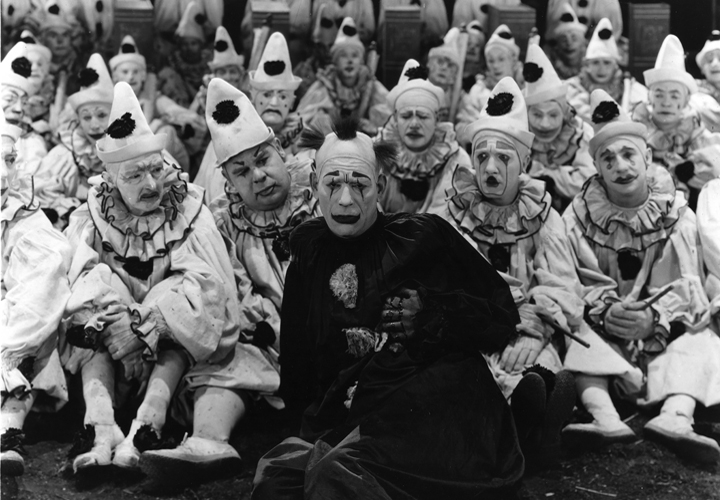
Clowns marry comedy and tragedy harmoniously, truly embodying schadenfreude: when we see a clown spray another in the face with a seltzer bottle, we laugh at their misfortunes because we too can sympathise with the indignation of public humiliation and betrayal from our friends. In essence, the clown character represented the people and became something both recognisable and relatable.

Tragedy into horror


It (1990)

The true frontrunner of clowns in the horror genre is undoubtedly Pennywise, a nightmare-inducing shapeshifter dreamed up by Stephen King in the 1980s. When It (1990) was released, the world was in a frenzy over this killer clown, appalled by the subversion of a children's entertainer being something of a monster.

The reason, I believe, that clowns are considered scary and phobia-worthy is because their nature is to be childlike and innocent, unseeming and jovial. What was once considered a character that we could sympathise with and laugh at has transformed into a character of deception, murderous intent and leaves you with an unwavering sense of unease (much like the trope of children and animals in horror films, which Stephen King has also explored with Pet Sematary (1989) and Cujo (1983)). 

Pennywise, however, stands out because his character is supernatural: It, so to speak, is an alien entity that landed on Earth and rises every 27 years to eat people like animal crackers. The true nature of clowns in horror is that they could be anyone, they could be a neighbour or a friend or just some entertainer hired to ruin your 6-year old's birthday party: they're one of us, masked by makeup and a fake smile.

Ranked: Iconic Clowns


So, who is the best horror clown? Well, I've listed a few of my favourites below with their name, origin movie and why (in my opinion) they cause such a visceral reaction from their intended audiences.

It (2017)

Pennywise

Played by: Bill Skarsgård
Who is he?: A cosmic entity who came to earth and rises every 27 years to feed on humans
Scare rating: 7/10. His 1990 incarnation (famously played by Tim Curry) was too whimsical and likable to be scary and I think that, despite the enlarged forehead, Skarsgård is also pretty simplistic until he bears his teeth. The wandering eyes is absolutely creepy, though.

House of 1000 Corpses (2003)

Captain Spaulding

Played by: Sid Haig
Who is he?: The owner of Captain Spaulding's Museum of Monsters and Madmen, a lover of fried chicken and murdering innocent people, and a lovable asshole.
Scare rating: 5/10. In general, Spaulding's appearance isn't hugely threatening, at least not as much as the gun he wields or the verbally abusive things he says. His look is iconic, however, and I consider him to be my favourite horror clown.

Zombieland (2009)

Clown Zombie

Played by: Derek Graf
Who is he?: Simply referred to in the credits as 'Clown Zombie', this absolute mad-lad was never actually named in the film, so your guess is as good as mine!
Scare rating: 8/10. Besides the eye-watering, gaudy outfit, I think it's safe to assume that anyone would be terrified of this guy. He's a clown and he's an undead cannibal: you do the math.

Gacy (2003)

Pogo

Played by: Mark Holton
Who is he?: Unfortunately, this one is based in reality. Pogo represents the real life serial killer John Wayne Gacy, who kidnapped and murdered young men in the 70s.
Scare rating: 6/10. On appearance alone, Pogo is more so grotesque than he is scary, but there's something unnerving about the bold colours across his mouth and eyes and the fact that he was modelled after a man who committed truly disturbing crimes.

Killer Klowns from Outer Space (1988)

Klown Performers

Played by: Various people
Who are they?: As the title suggests, these are "klowns", which are basically aliens who look like interpretative versions of clowns. 
Scare rating: 9/10. Look at them. These things look absolutely insane, like caricatures of clowns on acid or Mr Blobby wearing a skin suit. The entire film is based on how people don't take them seriously because of how ridiculous they look and yet they're secretly dangerous, which I think is complete horseshit: if I saw these things coming, I'd run a mile in the opposite direction. 

Terrifier (2016)

Art

Played by: David Howard Thornton
Who is he?: Art the Clown is an enigmatic serial killer who seemingly possesses supernatural abilities and derives enjoyment from torturing his victims
Scare rating: 8/10. Art's character is, stylistically speaking, incredibly innovative and intimidating: modelled on the clown archetype of 'Pierrot', he dons a monochromatic look and a smile that would make Conrad Veidt proud. I think what makes Art perfect for horror is his silent demeanour: his lack of empathy and communication makes for a wonderfully demonic portrayal of an unhinged human being, masquerading as a clown blanc. 

Honourable mentions

Twisty (John Carroll Lynch) - American Horror Story (2011-)
Stitches (Ross Noble) - Stitches (2012)
Frowny (Eli Roth) - Clown (2014)
Gwynplaine (Conrad Veidt) - The Man Who Laughs (1928)

Clown pandemic


You might now be wondering if I am afraid of clowns and, truthfully, I have to say I'm not. I appreciate why people are afraid of them but to me, they're just performers in eccentric makeup: the only thing I find horrific about them is their constant need for audience participation...no thanks.

So, are clowns meant to be feared? Are they really that scary? I suppose that isn't for me to say but my unsolicited opinion is that there isn't anything to be afraid of. Coulrophobia, unless instigated by PTSD/severe trauma, is an irrational fear: that isn't to invalidate anybody's phobia of clowns but it is to say that there isn't a definitive reason as to why clowns are scary.

The Man Who Laughs (1928)

Many people cite Pennywise as the source of clown discomfort, as he became a popular figure in horror culture: others derive their fear from monsters such as John Wayne Gacy, who wasn't a fictional character but a real person in clown makeup, luring people into a false sense of security and butchering them. I've even heard of someone on Reddit who fears clowns due to the Joker character from the DC franchise.

It's interesting to me that such an innocent and enjoyable character has been subverted to be a thing of nightmares, a collective posterboy for perverse and chaotic death. I imagine the trope of 'evil clown' will wear out its welcome eventually: I wouldn't mind seeing a horror film where the clown is the hero/sidekick, just to subvert the subversion for once.

- K